


Page 34 - JSOM Spring 2018
P. 34
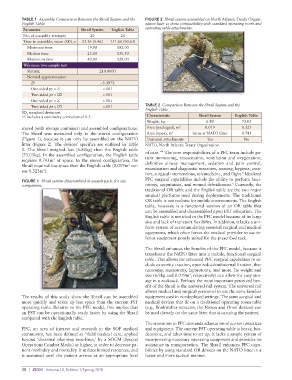
TABLE 1  Assembly Comparison Between the Shrail System and the   FIGURE 2  Shrail system assembled on North Atlantic Treaty Organi-
          English Table                                      zation litter to show compatibility with standard operating room and
           Parameter               Shrail System  English Table  operating table attachments.
           No. of assembly attempts   20           20
           Time to assemble, mean (SD), s  23.36 (5.46)  151.60 (90.63)
             Minimum time            19.90       102.00
             Median time             25.10       130.50
             Maximum time            40.00       528.00
           Wilcoxon two-sample test
             Statistic                    210.0000
             Normal approximation
              Z a                          −5.3973
              One-sided pr < Z             <.001
              Two-sided pr > |Z|           <.001
              One-sided pr < Z             <.001
              Two-sided pr > |Z|           <.001             TABLE 2  Comparison Between the Shrail System and the
                                                             English Table
          SD, standard deviation.
          a Z includes a continuity correction of 0.5.        Characteristic       Shrail System  English Table
                                                              Weight, kg              6.80           73.03
          stored (with storage container) and assembled configurations.   Area (packaged), m 3  0.019  0.323
          The  Shrail  was  measured  only  in  the  stored  configuration   Area (open), m 3  Same at NATO litter  0.745
          (Figure 1), because it can only be assembled on the NATO   Universal attachments  Yes       No
          litter (Figure 2). The devices’ specifics are outlined in Table   NATO, North Atlantic Treaty Organization.
          2. The Shrail weighed less (6.80kg) than the English table   4
          (73.03kg). In the assembled configuration, the English table   of care.”  The core responsibilities of a PFC team include pa-
                       3
          requires 0.745m  of space. In the stored configuration, the   tient monitoring, resuscitation, ventilation and oxygenation,
          Shrail required less space than the English table (0.019m  ver-  definitive airway management, sedation and pain control,
                                                      3
          sus 0.323m ).                                      examination and diagnostic measures, nursing, hygiene, com-
                   3
                                                             fort, surgical interventions, telemedicine, and flight.  Idealized
                                                                                                     5
          FIGURE 1  Shrail system disassembled in assault pack, for size   PFC surgical capabilities include the ability to perform fasci-
                                                                                                 5
          comparison.                                        otomy, amputation, and wound debridement.  Currently, the
                                                             traditional OR table and the English table are the two major
                                                             surgical platforms used during deployments. The traditional
                                                             OR table is not realistic for mobile environments. The English
                                                             table, however, is a functional version of an OR table that
                                                             can be assembled and disassembled upon FST relocation. The
                                                             English table is not ideal in the PFC model because of its large
                                                             size and lack of transport flexibility. In addition, it lacks a uni-
                                                             form system of accommodating essential surgical and medical
                                                             equipment, which often forces the medical provider to use in-
                                                             ferior equipment poorly suited for the prescribed task.
                                                             The Shrail enhances the benefits of the PFC model, because it
                                                             transforms the NATO litter into a mobile, functional surgical
                                                             table. This allows for enhanced PFC surgical capabilities to in-
                                                             clude extremity traction, open reduction/internal fixation, tho-
                                                             racotomy, sternotomy, laparotomy, and more. Its weight and
                                                                               3
                                                             size (6.8kg and 0.019m , respectively) can allow for easy stor-
                                                             age in a rucksack. Perhaps the most important perceived ben-
                                                             efit of the Shrail is the universal rail system. The universal rail
                                                             allows medical and surgical personnel to use the same familiar
          The results of this study show the Shrail can be assembled   equipment used in nondeployed settings. The same surgical and
          more quickly and takes up less space than the current FST   medical devices that fit on a traditional operating room table
          operating table. Relative to the PFC model, this implies that   (e.g., Bookwalter retractor, the Nissen and Omni devices) can
          an FST can be operationally ready faster by using the Shrail   be used directly on the same litter that is carrying the patient.
          compared with the English table.
                                                             The transition to PFC demands adaptation of current practices
          PFC, an area of interest and research in the SOF medical   and equipment. The current FST operating table is heavy, bur-
          community, has been defined as “field medical care, applied   densome, and takes time to set up. It lacks a simple system of
          beyond ‘doctrinal planning time-lines,’ by a SOCM (Special   incorporating necessary operating equipment and provides no
          Operations Combat Medic) or higher, in order to decrease pa-  assistance in transportation. The Shrail enhances PFC capa-
          tient morbidity and mortality. It utilizes limited resources, and   bilities by using standard OR devices on the NATO litter in a
          is sustained until the patient arrives at an appropriate level   faster and more tactical manner.


          30  |  JSOM   Volume 18, Edition 1/Spring 2018

