


Page 29 - JSOM Spring 2018
P. 29
A portable chest radiograph showed the ETT was in the tra-  edema secondary to volume overload. The patient tolerated
              chea approximately 10cm above the carina with no evidence   a spontaneous ventilator mode with Fio  of 40%, pressure
                                                                                                 2
              of acute cardiopulmonary abnormalities. The ventilator respi-  support of 10cmH O, and PEEP of 5cmH O. He maintained
                                                                                                  2
                                                                               2
              ratory rate was increased to 18/min to reduce the respiratory   stable Sao  at 99%–100%, with RR of 18–20 bpm.
                                                                        2
              acidosis. Deep tracheal suctioning was performed and the ETT
              was advanced 2cm. During this intervention, telemetry showed   The norepinephrine bitartrate drip was stopped at 01:00, 11
              a 6-beat run of ventricular tachycardia then an 8-beat run fol-  hours after ICU admission. The bicarbonate drip was stopped
              lowed by sinus bradycardia with ventricular rate 51 bpm. The   at 07:00, when arterial pH consistently was >7.1 (Figure 2).
              crash cart was opened. An IV push of 1g of calcium chloride   Serial laboratory test results were significant for resolution of
              and sodium bicarbonate 50mEq was given and the patient’s   DKA (blood glucose, 180mg/dL; anion gap, 10mmol/L), reso-
              hemodynamics stabilized. With a MAP of 60mmHg and HR   lution of hyperkalemia, and normal iCa. No infectious source
              of 106 bpm, the patient’s repeated 12-lead electrocardiogram   of the patient’s DKA was identified, either on imaging or by
              showed sinus tachycardia.                          laboratory studies, and antibiotics were discontinued. The pa-
                                                                 tient was transferred; receiving an insulin drip and minimal,
              Once cardiac arrest was averted, a 7.5F, multilumen, central   invasive mechanical ventilation settings, via air ambulance to
              venous catheter was placed in the patient’s left internal jugu-  definitive care in a neighboring country.
              lar vein, and a left femoral arterial line was placed. Repeated
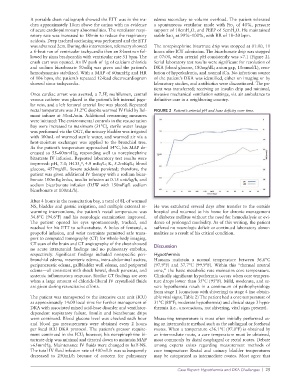
              rectal temperature was 31.2°C despite warmed IV fluid by Bel-  FIGURE 2  Patient’s arterial pH and base deficity over time.
              mont infuser at 50mL/min. Additional rewarming measures
              were initiated: The environmental controls in the resuscitation
              bay were increased to maximum (31°C), sterile water lavage
              was performed via the OGT, the urinary bladder was irrigated
              with 300mL of warmed sterile water, and warmed air via a
              heat-moisture exchanger was applied to the bronchial tree.
              As the patient’s temperature approached 34°C, his MAP de-
              creased  to  55–60mmHg,  responding  well  to  norepinephrine
              bitartrate IV infusion. Repeated laboratory test results were
              improved: pH, 7.0; HCO − , 4.9 mEq/L; K, 5.2mEq/L; blood

                                  3
              glucose, 457mg/dL. Severe acidosis persisted; therefore, the
              patient was given additional IV therapy with a sodium bicar-
              bonate 100mEq bolus, insulin infusion at 0.15 unit/kg/h, and
              sodium bicarbonate infusion (D5W with 150mEq/L sodium
              bicarbonate at 100mL/h).

              After 4 hours in the resuscitation bay, a total of 8L of warmed
              NS, bladder and gastric irrigation, and multiple external re-  He was extubated several days after transfer to the outside
              warming interventions, the patient’s rectal temperature was   hospital  and  returned  to  his  home  for  chronic  management
              34.8°C (94.6°F) and his neurologic examination improved.   of diabetes mellitus without the need for hemodialysis or evi-
              The patient opened his eyes spontaneously, tracked, and   dence of prolonged morbidity. As of this writing, the patient
              reached for his ETT to self-extubate. A bolus of fentanyl, a   suffered no neurologic deficit or continued laboratory abnor-
              propofol infusion, and wrist restraints permitted safe trans-  malities as a result of his critical condition.
              port to computed tomography (CT) for whole-body imaging.
              CT scan of the brain and CT angiography of the chest showed   Discussion
              no acute intracranial findings and no pulmonary embolus,
              respectively. Significant  findings  included  nonspecific  peri-  Hypothermia
              bronchial edema, mesenteric edema, intra-abdominal ascites,   Humans maintain a normal temperature between 36.6°C
              peripancreatic edema, gallbladder wall edema, and periportal   (97.9°F) and 37.7°C (99.9°F). Within this “thermal neutral
              edema—all consistent with shock bowel, shock pancreas, and   zone,” the basic metabolic rate maintains core temperature.
              systemic inflammatory response. Similar CT findings are seen   Clinically significant hypothermia occurs when core tempera-
              when a large amount of chloride-liberal IV crystalloid fluids   ture drops lower than 35°C (95°F). Mild, moderate, and se-
              are given during resuscitative efforts.            vere hypothermia result in a continuum of pathophysiology
                                                                 from stage 1 (conscious with shivering) to stage 4 (no obtain-
              The patient was transported to the intensive care unit (ICU)   able vital signs; Table 2) The patient had a core temperature of
              at approximately 14:00 local time for further management of   31°C (88°F; moderate hypothermia) and clinical stage 3 hypo-
              DKA with associated mixed acid-base disorder and ventilator-  thermia (i.e.. unconscious, not shivering, vital signs present).
              dependent respiratory failure. Insulin and bicarbonate drips
              were continued. Blood glucose level was checked each hour   Measuring temperature is most often initially performed us-
              and blood gas measurements were obtained every 2 hours   ing an intermediate method such as the sublingual or forehead
              per local ICU DKA protocol. The patient’s pressor require-  routes. When a temperature <36.1°C (97.0°F) is obtained by
              ment continued in the ICU; however, his norepinephrine bi-  an intermediate route, a core temperature must be obtained,
              tartrate drip was minimal and titrated down to maintain MAP   most commonly by distal esophageal or rectal routes. Debate
              >65mmHg. Maintenance IV fluids were changed to half-NS.   among  experts  exists  regarding  measurement  methods  of
              The total IV fluid infusion rate of 400mL/h was subsequently   core temperature: Rectal and urinary bladder temperatures
              decreased to 250mL/h because of concern for pulmonary   may be categorized as intermediate routes. Most agree that

                                                                          Case Report: Hypothermia and DKA Challenges  |  25

