


Page 25 - JSOM Spring 2018
P. 25
Discussion                                         form of evidence-based protocols, quality assurance reviews,
                                                                 and online support should help guide care. Preidentified pa-
              This case demonstrates the importance of critical care skills   tient-receiving centers like trauma centers and emergency de-
              and the ability to perform advanced life-saving interventions in   partments  ready  and  able  to  receive  critical  patients  should
              the prehospital setting. According to the director of the receiv-  also  be considered.  In our  case,  a quality  assurance  review
              ing trauma center and on-call surgeon (E. M. Bulger, written   might lead to a discussion of the increased risk of aspiration
              communication, January 2017), the prehospital, Paramedic-  with bag-valve-mask–assisted respirations in a patient with
              level, critical care interventions saved the lives of these two   altered mental status and confirm the decision to intubate. A
              aviators. Specifically, rapid sequence induction, endotracheal   discussion of the clinical value of hyperventilation as a strat-
              intubation, needle decompression thoracostomy, and admin-  egy to temporize traumatic brain injury without evidence of
              istration of medications via IV infusion are defined as Para-  herniation might increase the knowledge of the providers and
                                                             3
              medic skills by the National EMS Scope of Practice Model    benefit future patients. Reviewing the initial examination find-
              and likely improved the outcome for both of these patients.   ings of absent breath sounds on the left and decreased breath
              While this concept is not novel, especially for prehospital pro-  sounds on the right could lead to encouraging the SMT to
              viders who support military operations, the US Navy has yet   perform bilateral needle decompression thoracostomy for
              to adopt a formal policy requiring SMTs to earn and maintain   blast-injured patients in the future, especially in the setting of
              Paramedic certification.
                                                                 declining respiratory status after multiple decompressions on
                                                                 the same side.
              In 2012, the US Congress
              mandated  that  the  US Army                                                We could use this case as an
              train their DUSTOFF Med-                                                    excellent example of the need
              ics to the Critical Care Flight                                             for frequent reassessments,
              Paramedic standard.  The US                                                 as the providers did, and re-
                              4
              Air Force has been training                                                 inforce the potential need to
              and certifying their PJs to the                                             repeat an intervention (ie,
              National Registry of EMT                                                    needle  decompression  tho-
              Paramedic  standard  since                                                  racostomy). The impact of
              1995. As in this case report,                                               positive pressure ventilation
              Sailors and Marines who are                                                 on a patient with a suspected
              cared  for  by Navy  medicine                                               pneumothorax  would  also
              providers can benefit from a                                                be  a  valuable  learning  point
              similar standard of care. Both                                              from  this case.  These  items
              SMTs involved in this case                                                  are mentioned to acknowl-
              report are National Registry                                                edge that the care presented
              Paramedic and Critical Care                                                 in this case report was not
              Flight Paramedic certified.                                                 perfect and, more impor-
              They are also the only two                                                  tantly, to emphasize the value
              SMTs in the current inven-                                                  of a systematic approach to
              tory of 71 qualified SMTs to                                                support improvements in
              hold both certifications.                                                   Navy prehospital care.
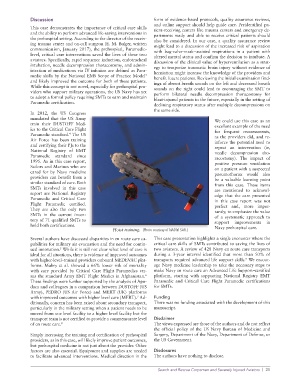
                                                Hoist training.  (Photo courtesy of NASWI SAR.)
              Several authors have discussed disparities in en route care ca-  This case presentation highlights a single encounter where the
              pabilities for military air evacuation and the need for contin-  critical care skills of SMTs contributed to saving the lives of
              ued innovation.  While it is still not clear what level of care is   two aviators. A review of 428 Navy en route care transports
                          5
              ideal for all situations, there is evidence of improved outcomes   during a 3-year interval identified that more than 50% of
              with higher-level–trained providers onboard MEDEVAC plat-  transports required advanced life support skills.  We encour-
                                                                                                      9
              forms. Mabry et al. showed a 66% lower risk of mortality   age Navy medicine leadership to take the necessary steps to
              with care provided by Critical Care Flight Paramedics ver-  make Navy en route care an Advanced Life Support–certified
              sus the standard Army EMT Flight Medics in Afghanistan.    platform, starting with supporting National Registry EMT
                                                             6
              These findings were further supported by the analysis of Apo-  Paramedic and Critical Care Flight Paramedic certifications
              daca and colleagues in a comparison between DUSTOFF (US   for SMTs.
              Army), PEDRO (US Air Force) and MERT (UK) platforms
              with improved outcomes with higher level care (MERT).  Ad-  Funding
                                                          7
              ditionally, concern has been raised about secondary transport,   There was no funding associated with the development of this
              particularly in the military setting when a patient needs to be   manuscript.
              moved from one level facility to a higher level facility but the
              transport team is not certified to provide a commensurate level   Disclaimer
              of en route care. 8                                The views expressed are those of the authors and do not reflect
                                                                 the official policy of the US Navy Bureau of Medicine and
              Simply increasing the training and certification of prehospital   Surgery, Department of the Navy, Department of Defense, or
              providers, as in this case, will likely improve patient outcomes,   the US Government.
              but prehospital medicine is not just about the provider. Other
              factors are also essential. Equipment and supplies are needed   Disclosures
              to facilitate advanced interventions. Medical direction in the   The authors have nothing to disclose.

                                                                  Search and Rescue Corpsmen and Severely Injured Aviators  |  21

