


Page 24 - JSOM Spring 2018
P. 24
pain and difficulty breathing. He was lying on his right side,   Patient 2’s mental status declined and O  saturation fell to
                                                                                              2
          which was his position of maximal comfort. A C-collar was   76% shortly after takeoff. The SMT administered a second
          in place with a firefighter also holding manual stabilization of   dose  of  75mg ketamine  IV  and performed a  second  needle
          C-spine. He was breathing 100% O  via a nonrebreather mask   decompression at the left fifth intercostal space, midaxillary
                                     2
          at 15L/min. Primary survey revealed no evidence of massive   line, which resulted in an increased O  saturation to 88%.
                                                                                            2
          bleeding. His airway was patent but with mild stridor and rat-  Nine minutes later, the patient experienced another drop in
          tling on expiration; breathing was labored with breath sounds   O  saturation to 78%, and a third left-sided needle decom-
                                                               2
          absent on the left and diminished on right. Distal extremity   pression was performed with a response to 84%. The pa-
          pulses were strong but the skin was cool and diaphoretic.   tient  then began to clench his  jaw and  flex all extremities.
          There were no obvious chest, pelvic, or extremity injuries   The SMT administered ketamine 150mg IV and attempted to
          and no external sources of bleeding. Patient 2’s abdominal   insert a King LTD airway but was unsuccessful due to the pa-
          examination revealed ecchymosis in the upper quadrants at   tient biting down on the tube. The patient was still maintain-
          the level of the diaphragm and was tender and distended in   ing  spontaneous  respirations  but  had  another  desaturation,
          all four quadrants. Initial GCS was 15. The patient was fully   which responded to a fourth needle decompression of the left
          exposed and hypothermia precautions were taken. Initial vital   chest. The SMT performed a fifth and final needle decom-
          signs were blood pressure of 111/70, pulse of 77, normal sinus   pression, which resulted in blood return and a less significant
          rhythm, respiratory rate of 30, and O  saturation of 74% . The   increase in O  saturation.
                                       2
                                                                       2
          SMT was concerned for barotrauma and a developing tension
          pneumothorax.                                      The helicopter arrived as scheduled to the urban trauma cen-
                                                             ter, and the patients were transferred to the awaiting trauma
                                                             team.

                                                             Trauma Center
                                                             Evaluation of patient 1 at the trauma center revealed bi frontal
                                                             and left temporal contusions that were consistent with a coup-
                                                             contracoup injury, intraparenchymal contusions, and subarach-
                                                             noid hemorrhage. Facial fractures included the right frontal
                                                             bone and a segmented depressed right orbital roof fracture with
                                                             adjacent hematoma. The patient was admitted to the neurologic
                                                             intensive care unit and given hypertonic saline boluses for in-
                                                             creased ICP. His ICP normalized on hospital day 7, and he was
                                                             extubated the following day. Surgery was performed to repair
                                                             the facial fractures, and he underwent inpatient therapy for
                                                             4 weeks. After home rehabilitation, he went back to work in a
                                                             limited duty status.
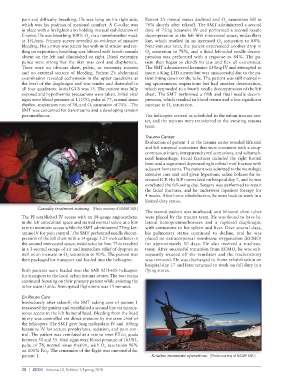
                Casualty treatment training.  (Photo courtesy of NASWI SAR.)
                                                             The second patient was intubated, and bilateral chest tubes
          The PJ established IV access with an 18-gauge angio catheter   were placed by the trauma team. He was found to have bi-
          in the left antecubital space and started normal saline at a low   lateral hemopneumothoraces and a ruptured diaphragm,
          rate to maintain access while the SMT administered 75mg ket-  with contusions to his spleen and liver. Over several days,
          amine IV for pain control. The SMT performed needle decom-  his  pulmonary  status  continued  to  decline,  and  he  was
          pression of the left chest with a 14-gauge 3.25-inch catheter in   placed on extracorporeal membrane oxygenation (ECMO)
          the second intercostal space, midclavicular line. This resulted   for approximately 10 days. He also received a tracheos-
          in a 3-second escape of air and immediate relief of dyspnea as   tomy. After successful transition from ECMO, he was sub-
          well as an increase in O  saturation to 90%. The patient was   sequently weaned off the ventilator and the tracheostomy
                             2
          then packaged for transport and loaded into the helicopter.  was removed. He was discharged to home rehabilitation on
                                                             hospital day 17 and later returned to work on full duty in a
          Both patients were loaded into the SAR MH-60S helicopter   flying status.
          for transport to the local urban trauma center. The two teams
          continued focusing on their primary patient while assisting the
          other team if able. Anticipated flight time was 15 minutes.

          En Route Care
          Immediately after takeoff, the SMT taking care of patient 1
          reassessed the patient and established a second line via intraos-
          seous access to the left humeral head. Bleeding from the head
          injury was controlled via direct pressure by the crew chief of
          the helicopter. The SMT gave 5mg midazolam IV and 100mg
          ketamine IV for seizure prophylaxis, sedation, and pain con-
          trol. The patient was ventilated at a rate to meet ETco  goals
                                                     2
          between 30 and 35. Vital signs were blood pressure of 165/85,
          pulse of 78, normal sinus rhythm, with O  saturation 96%
                                            2
          on 100% Fio . The remainder of the flight was uneventful for
                    2
          patient 1.                                           Routine mountain operations.  (Photo courtesy of NASWI SAR.)

          20  |  JSOM   Volume 18, Edition 1/Spring 2018

