


Page 146 - JSOM Spring 2018
P. 146
subsequent recommendation against this technique in favor of   possible at the risk of not focusing on the basics. Master the
          surgical airways as the definitive airway of choice for most   basics, and don’t be distracted by another new, shiny object.
          SOF Medics.
                                                             The authors rightly caveat the introduction of this new tech-
          Last, in the current context of limited training time and clini-  nology and propose further study and research, as well as the
          cal practice time, there exists only a finite amount of time for   potential introduction for consideration by other Combat Ca-
          training and implementation of any patient management tech-  sualty Care focus groups. Their provocative report is interest-
          niques. If we are to embrace a new technology, what other   ing and presents challenging questions to be considered. It also
          training or education will we cut out of the current curricu-  provides a forum to present the greater challenges of assess-
          lum? As operational planners and trainers, we currently strug-  ing technology for recommended use in the PFC environment.
          gle to implement accepted practice standards that we know   “. . . will ECMO ever play a role?” I don’t know—but it
          would benefit our patients. The latest training challenge for   shouldn’t, in the SOF PFC space, right now.
          many, undoubtedly, is ensuring the initiation of fresh whole
          blood transfusions as close to the point of injury as possible.                      Sean Keenan, MD
          With such current challenges with easier tasks, I would sub-                 Steering Committee Member
          mit that the SOF medical community should focus on these     Special Operations Medical Association (SOMA)
          obvious challenges and leave the academic discussions to the   Prolonged Field Care Working Group (PFC WG)
          scientists to study further, rather than jump at the potentially


                                     American Heart Association News

          Current American Heart Association News items include “Not enough sleep can hurt your health,” “Women are less
          likely to get CPR from bystanders,” “Stopping daily aspirin dose can prove deadly,” and “Study: Almonds and dark
          chocolate lower bad cholesterol.”

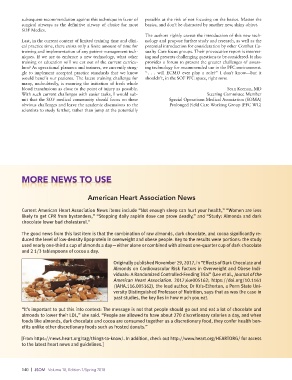
          The good news from this last item is that the combination of raw almonds, dark chocolate, and cocoa significantly re-
          duced the level of low-density lipoprotein in overweight and obese people. Key to the results were portions: the study
          used nearly one-third a cup of almonds a day—either alone or combined with almost one-quarter cup of dark chocolate
          and 2 1/3 tablespoons of cocoa a day.

                                                Originally published November 29, 2017, in “Effects of Dark Chocolate and
                                                Almonds on Cardiovascular Risk Factors in Overweight and Obese Indi-
                                                viduals: A Randomized Controlled-Feeding Trial” (Lee et al., Journal of the
                                                American Heart Association.  2017;6:e005162; https://doi.org/10.1161
                                                /JAHA.116.005162), the lead author, Dr Kris-Etherton, a Penn State Uni-
                                                versity Distinguished Professor of Nutrition, says that as was the case in
                                                past studies, the key lies in how much you eat.

          “It’s important to put this into context: The message is not that people should go out and eat a lot of chocolate and
          almonds to lower their LDL,” she said. “People are allowed to have about 270 discretionary calories a day, and when
          foods like almonds, dark chocolate and cocoa are consumed together as a discretionary food, they confer health ben-
          efits unlike other discretionary foods such as frosted donuts.”

          [From https://news.heart.org/tag/things-to-know/. In addition, check out http://www.heart.org/HEARTORG/ for access
          to the latest heart news and guidelines.]


          140  |  JSOM   Volume 18, Edition 1/Spring 2018

