


Page 143 - JSOM Spring 2018
P. 143
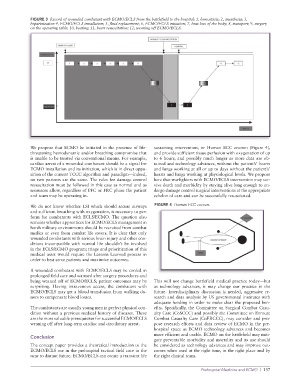
FIGURE 3  Record of wounded combatant with ECMO/ECLS from the battlefield to the hospital: 1, hemostasis; 2, anesthesia; 3,
              heparinization 4, ECMO/ECLS installation; 5, fluid replacement; 6, ECMO/ECLS initiation; 7, heat loss of the body; 8, transport; 9, surgery
              on the operating table; 10, heating; 11, heart resuscitation; 12, weaning off ECMO/ECLS.


              We propose that ECMO be initiated in the presence of life-  sustaining  intervention,  or Human ECC  cocoon  (Figure  4),
              threatening hemodynamic and/or breathing compromise that   and provide sufficient tissue perfusion with oxygenation of up
              is unable to be treated via conventional means. For example,   to 6 hours, and possibly much longer as more data are ob-
              cardiac arrest of a wounded combatant should be a signal for   tained and technology advances, without the patient’s’ hearts
              ECMO installation and its initiation, which is in direct oppo-  and lungs working at all or up to days without the patient’s’
              sition of the current TCCC algorithm and paradigm—indeed,   hearts and lungs working at physiological levels. We propose
              no two patients are the same. The rules for damage control   here that warfighters with ECMO/ECLS intervention may sur-
              resuscitation must be followed in this case as normal and as   vive death and morbidity by staying alive long enough to un-
              resources allow, regardless of PFC or FRC phase the patient   dergo damage control surgical interventions at the appropriate
              and team may be operating in.                      echelon of care and can be successfully resuscitated.
              We do not know whether LSI which should secure airways   FIGURE 4  Human ECC cocoon.
              and sufficient breathing with oxygenation, is necessary to per-
              form  for combatants  with ECLS/ECMO.  The  question  also
              remains whether apprentices for ECMO/ECLS management in
              harsh military environments should be recruited from combat
              medics or even from combat life savers. It is clear that only
              wounded combatants with serious brain injury and other con-
              ditions incompatible with normal life shouldn’t be involved
              in the ECLS/ECMO program; triage and prioritization of this
              medical asset would require the Lessons Learned process in
              order to best serve patients and maximize outcomes.

              A wounded combatant with ECMO/ECLS may be cooled in
              prolonged field care and warmed after surgery procedures and
              being weaned off of ECMO/ECLS; patient outcomes may be   This will not change battlefield medical practice today—but
              surprising. Having intravenous access, the combatant with   as technology advances, it may change our practice in the
              ECMO/ECLS may get a blood transfusion from walking do-  future. Interdisciplinary discussion is needed, aggressive re-
              nors to compensate blood losses.                   search and data analysis by US governmental institutes with
                                                                 adequate funding in order to make clear the proposed ben-
              The combatants are usually young men in perfect physical con-  efits. Specifically, the Committee on Surgical Combat Casu-
              dition without a previous medical history of diseases. These   alty Care (CoSCCC) and possibly the Committee on Enroute
              are the most valuable prerequisites for successful ECMO/ECLS   Combat Casualty Care (CoERCCC), may consider and pro-
              weaning off after long-term cardiac and circulatory arrest.  pose research efforts and data review of ECMO in the pre-
                                                                 hospital space as ECMO technology advances and becomes
                                                                 more efficient and usable. ECMO on the battlefield may miti-
              Conclusion
                                                                 gate preventable morbidity and mortality and its use should
              The concept paper provides a theoretical introduction to the   be considered as technology advances and may improve out-
              ECMO/ECLS use in the prehospital tactical field care in the   comes when used at the right time, in the right place and by
              near to distant future. ECMO/ECLS can create a transient life   the right clinical team.

                                                                                    Prehospital Medicine and ECMO  |  137

