


Page 148 - JSOM Spring 2018
P. 148
Patella Fracture in US Servicemember
                                             in an Austere Location


                                                                                                      3
                                                                            2
                                         1
                Sophia Schermerhorn, BS ; Paul J. Auchincloss, APA-C, MPAS ; Kyle Kraft, EMT-B; LTC(P) ;
                                                                                        5
                             Kenneth J. Nelson, MD ; Jeremy Pamplin, MD, FCCM, FACP *
                                                    4


          ABSTRACT
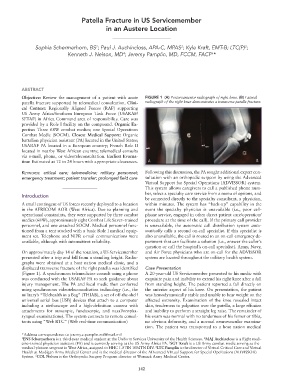
          Objective:  Review the management of a patient with acute   FIGURE 1  (A) Posteroanterior radiograph of right knee. (B) Lateral
          patella fracture supported by telemedical consultation. Clini-  radiograph of the right knee demonstrates a transverse patella fracture.
          cal Context:  Regionally Aligned Forces (RAF) supporting
          US  Army  Africa/Southern  European  Task  Force  (USARAF/
          SETAF) in Africa Command area of responsibility. Care was
          provided by a Role I facility on the compound. Organic Ex-
          pertise:  Three 68W combat medics; one Special Operations
          Combat Medic (SOCM).  Closest Medical Support:  Organic
          battalion physician assistant (PA) located in the United States;
          USARAF PA located in a European country; French Role II
          located in nearby West African country; telemedical consults
          via e-mail, phone, or videoteleconsultation. Earliest Evacua-
          tion: Estimated at 12 to 24 hours with appropriate clearances.

          Keywords:  critical care; telemedicine; military personnel;   Following this discussion, the PA sought additional expert con-
          emergency treatment; patient transfer; prolonged field care  sultation with an orthopedic surgeon by using the Advanced
                                                             Virtual Support for Special Operations (ADVISSOR) system.
                                                             This system allows caregivers to call a published phone num-
                                                             ber, select a specialty care service from a menu of options, and
          Introduction
                                                             be connected directly to the specialty consultant, a physician,
          A small contingent of US forces recently deployed to a location   within minutes. The system has “back-up” capability in the
          in the AFRICOM AOR (West Africa). Due to planning and   event the specialty physician is unavailable (i.e., poor cell-
          operational constraints, they were supported by three combat   phone service, engaged in other direct patient care/operation/
          medics (68W), approximately eight Combat Life Saver–trained   procedure at the time of the call). If the primary call provider
          personnel, and one attached SOCM. Medical personnel func-  is unavailable, the automatic call distribution system  auto-
          tioned from a tent stocked with a basic Role I medical equip-  matically calls a second on-call specialist. If this specialist is
          ment set. Telephone and NIPR e-mail communications were   also unavailable, the call is routed to an on-call emergency de-
          available, although with intermittent reliability.  partment that can facilitate a solution (i.e., answer the caller’s
                                                             question or call the hospital’s on-call specialist). Army, Navy,
          On approximately day 14 of the rotation, a US Servicemember   and Air Force physicians who are on-call for the ADVISSOR
          presented after a trip and fall from a standing height. Radio-  system are located throughout the military health system.
          graphs were obtained at a host nation medical clinic, and a
          displaced transverse fracture of the right patella was identified   Case Presentation
          (Figure 1). A synchronous telemedicine consult using a phone   A 20-year-old US Servicemember presented to his medic with
          was conducted with the USARAF PA to seek guidance about   exquisite pain and inability to extend his right knee after a fall
          injury management. The PA and local medic then conferred   from standing height. The patient reported a fall directly on
          using synchronous videoteleconsultation technology (i.e., the   the anterior aspect of his knee. On presentation, the patient
          military’s “Telehealth in a Bag” [THIAB], a set of off-the-shelf   was hemodynamically stable and unable to bear weight on the
          universal serial bus [USB] devices that attach to a computer   affected extremity. Examination of the knee revealed intact
          including a stethoscope and a high-definition camera with   skin, tenderness to palpation over the patella, a large effusion
          attachments  for otoscopic,  funduscopic,  and nasal/oropha-  and inability to perform a straight leg raise. The remainder of
          ryngeal examinations). The system connects to remote consul-  his exam was normal with no tenderness of his femur or tibia,
          tants using “Web RTC” (Web real-time communication)  no obvious deformity, and a normal neurovascular examina-
                                                             tion. The patient was transported to a host nation medical
          *Address correspondence to jeremy.c.pamplin.mil@mail.mil
                                                                                     2
          1 ENS Schermerhorn is a third-year medical student at the Uniform Services University of the Health Sciences.  MAJ Auchincloss is a flight medi-
          cine–trained physician assistant (PA) and is currently serving as the US Army Africa PA.  SGT Kraft is a US Army combat medic serving as the
                                                                       3
          medical platoon sergeant in West Africa, assigned to HHC 1-87IN 10MTN DIV.  LTC Pamplin is the director of Virtual Critical Care and Virtual
                                                                 4
          Health at Madigan Army Medical Center and is the medical director of the ADvanced VIrtual Support for Special OpeRations (ADVISSOR)
          System.  COL Nelson is the Orthopedic Surgery Program director at Womack Army Medical Center.
                5
                                                          142

