


Page 153 - JSOM Spring 2018
P. 153
An Ongoing Series


                            You Never Know, Until You Know, and Then You Know

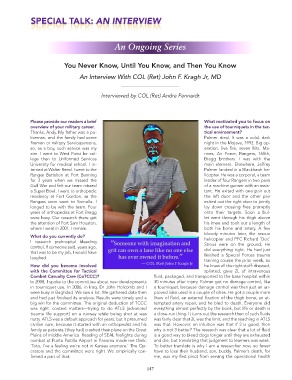
                                  An Interview With COL (Ret) John F. Kragh Jr, MD


                                           Interviewed by COL (Ret) Andre Pennardt


              Please provide our readers a brief                                     What motivated you to focus on
              overview of your military career.                                      the use of tourniquets in the tac-
              Thanks, Andy. My father was a po-                                      tical environment?
              liceman, and the family had some                                       Palmer died. It was a cold, dark
              firemen or military Servicepersons,                                    night in the Mojave, 1992. Big op-
              so, as a boy, such service was my                                      eration, live fire, seven hits. Ma-
              aim. I went to West Point for col-                                     rines, Air Force, Rangers, 160th,
              lege then to Uniformed Services                                        Bragg brothers. I was with the
              University for medical school. I in-                                   main element. Elsewhere, Jeffrey
              terned at Walter Reed. I went to the                                   Palmer landed in a Blackhawk he-
              Ranger Battalion at Fort Benning                                       licopter. He was a corporal, a team
              for 3 years when we missed the                                         leader of four Rangers in two pairs
              Gulf War and felt our team missed                                      of a machine gunner with an assis-
              a Super Bowl. I went to orthopedic                                     tant. He exited with one pair out
              residency  at  Fort  Gordon,  as  the                                  the left door and the other pair
              Rangers  soon  went to  Somalia.  I                                    exited out the right door to jointly
              longed to be with the team. Four                                       lay down crossing fires  promptly
              years of orthopedics at Fort Bragg                                     onto their targets. Soon a bul-
              were busy. Our research there got                                      let went through his thigh above
              the attention of Fort Sam Houston,                                     his knee and took out a length of
              where I went in 2001. I remain.                                        both his bone and artery. A few
                                                                                     bloody minutes later, the rescue
              What do you currently do?
              I  research  prehospital  bleeding   “Someone with imagination and     helicopter and PFC Richard ‘Doc’
              control. If someone said, years ago,                                   Strous were on the ground. He
              that was to be my job, I would have   grit can own a lane like no one else    did  everything  right.  He  had  just
              laughed.                            has ever owned it before.”         finished  a Special  Forces trauma
                                                                                     training course the prior week, so
              How did you become involved                  — COL (Ret) John F Kragh Jr  he knew all the right stuff: dressed,
              with the Committee for Tactical                                        splinted, gave 2L of intravenous
              Combat Casualty Care (CoTCCC)?                     fluid, packaged, and transported to the base hospital within
              In 2008, I spoke to the committee about new developments   30 minutes after injury. Palmer got no damage control, like
              in tourniquet use. In 2006, in Iraq, Dr John Holcomb and I   a tourniquet, because damage control was then just an un-
              were busy in Baghdad. We saw a lot. We gathered data then   proved idea used in a couple of cities. He got a couple more
              and had just finished its analysis. Results were timely and a   liters of fluid, an external fixation of the thigh bone, an at-
              big win for the committee. The original deduction of TCCC   tempted artery repair, and he bled to death. Everyone did
              was right: context matters—trying to do ATLS [advanced   everything almost perfectly by the book, but life or death is
              trauma life support] on a runway while being shot at was   a close-run thing. It turns out the research then of such fluids
              nutty. ATLS was a default approach for years, but it presumed   was fairly clear that 2L was the limit, and the teaching in ATLS
              civilian care, because it started with an orthopedist and his   was that. However, an intuition was that if 2 is good, then
              family as patients; [they had] crashed their plane on the Great   why is not 3 better? The research was clear that a lot of fluid
              Plains of middle America. Reading of SEAL firefights during   is a good way to bleed dogs longer until they are exhausted
              combat at Punta Paitilla Airport in Panama made me think:   and die, but translating that judgment to learners was weak.
              ‘Toto, I’ve a feeling we’re not in Kansas anymore.’ The Op-  To better translate is why I am a researcher now, so fewer
              erators and the committee were right. We empirically con-  have to lose their husband, son, buddy. Palmer’s death, for
              firmed a part of that.                             me, was my first pivot from serving the operational health

                                                              147

