


Page 157 - JSOM Spring 2018
P. 157
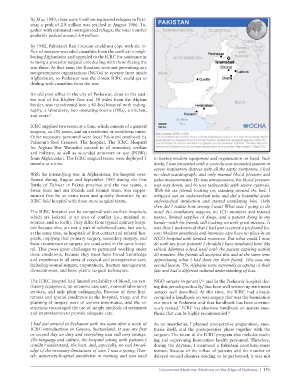
By May 1980, there were 1 million registered refugees in Paki-
              stan; a peak of 2.8 million was reached in August 1986. To-
              gether with estimated nonregistered refuges, the total number
              probably peaked around 3.4 million.

              By 1982, Pakistan’s Red Crescent could not cope with the in-
              flux of weapon-wounded casualties from the conflict in neigh-
              boring Afghanistan and appealed to the ICRC for assistance in
              running a specialist surgical unit dealing with those fleeing the
              war there. At that time, the Russians were not permitting any
              nongovernment organizations (NGOs) to operate from inside
              Afghanistan, so Peshawar was the closest ICRC could get to
              dealing with casualties from the war.

              An old post office in the city of Peshawar, close to the east-
              ern end of the Khyber Pass and 30 miles from the Afghan
              border, was transformed into a 60-bed hospital with radiog-
              raphy, a laboratory, two operating rooms (ORs), a kitchen,
              and more. 3

              ICRC supplied two teams at a time, which consists of a general
              surgeon, an OR nurse, and an anesthetist or anesthesia nurse.
              Other necessary personnel were local Pakistani employed by
              Pakistan’s Red Crescent. The hospital, The ICRC Hospital
              for Afghan War Wounded catered to all wounded, civilian
              and military, as well as wounded prisoners or war (POWs)
              from Afghanistan. The ICRC surgical teams were deployed 3   to having modern equipment and organization on hand. Sud-
              months at a time.                                  denly, I was presented with a severely war-wounded patient in
                                                                 severe respiratory distress with all the septic symptoms. I had
              With the intensifying war in Afghanistan, the hospital over-  no electrocardiograph, and only manual blood pressure and
              flowed during August and September 1985 during the first   pulse measurements. He was unresponsive, his blood pressure
              Battle  of Zahwar in Paktia province  and the two teams,  a   was way down, and he was tachycardic with severe cyanosis.
              Swiss team and our Danish and Finnish team, was supple-  With his six friends looking on, standing around the bed, I
              mented first by an extra team and quickly thereafter by an   whipped out an endotracheal tube and did a beautiful acute
              ICRC field hospital with three more surgical teams.  endotracheal intubation and started ventilating him. Only
                                                                 then did I realize how wrong I was! What was I going to do
              The ICRC hospital can be compared with civilian hospitals,   now? No ventilatory support, no ICU monitors and trained
              which  are  isolated  in  an  area  of  conflict  (i.e.,  minimal  re-  nurses, limited supplies of drugs, and a patient dying in my
              sources, and so forth). They differ from typical military hospi-  hands—with his friends still looking on with great interest. It
              tals because they are not a part of echeloned care, but work,   was then I understood that I had just received a profound les-
              at the same time, as hospitals of first contact and referral hos-  son: Modern anesthesia and intensive care have no place in an
              pitals, implying that primary surgery, secondary surgery, and   NGO hospital with limited resources. But what could I now
              basic reconstructive surgery are conducted in the same hospi-  do with my poor patient? I shouldn’t have intubated him! My
              tal. This poses great challenges to personnel working under   ethical dilemma solved itself with the patient expiring within
              these conditions, because they must have broad knowledge   10 minutes. His friends all accepted this and at the same time
              and experience in all areas of surgical and postoperative care,   appreciating what I had done for their friend. This was my
              including wound surgery, amputations, fracture management,   second lesson: The Afghanis were extremely accepting of their
              thoracotomies, and basic plastic surgical techniques.  fate and had a different cultural understanding of loss.

              The ICRC hospital had limited availability of blood, no ven-  NGO surgery in general,  and in the Peshawar hospital dur-
                                                                                    4,5
              tilatory equipment, no intensive care unit, minimal laboratory   ing this period specifically,  has been well written up with most
                                                                                     6
              services, and only plain radiography. Because of these limi-  aspects well described. At this time, the ICRC had already
              tations and special conditions in the hospital, triage and the   compiled a handbook on war surgery that was the foundation
              planning of surgery were of utmost importance, and the re-  our work in Peshawar and that handbook has been continu-
              strictions encouraged the use of simple methods of treatment   ously revised.  ICRC has also now handbook on austere anes-
                                                                           7
              and improvisation to provide adequate care.        thesia that can be highly recommended. 8
              I had just arrived in Peshawar with my team after a week of   As an anesthetist, I planned preoperative preparation, anes-
              ICRC introductions in Geneva, Switzerland. It was my first   thesia itself, and the postoperative phase together with the
              or second day on duty and everything was still very strange.   surgeon. The intent of the ICRC program also includes teach-
              The language and culture, the hospital setting with patients I   ing and supervising host-nation health personnel. Therefore,
              couldn’t understand, the heat, and, especially, no real knowl-  during the daytime, I mentored a Pakistani anesthetic-nurse
              edge of the necessary limitations of care. I was a young, Dan-  trainee. Because of the influx of patients and the number of
              ish,  university-hospital  anesthetist  in training  and was  used   delayed wound closures needing to be performed, it was not

                                                                   Uncommon Medicine: Medicine on the Edge of Darkness  |  151

