


Page 159 - JSOM Spring 2018
P. 159
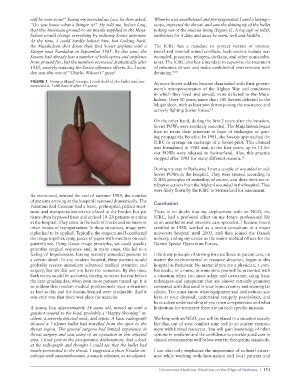
will be over soon!” Seeing my incredulous face, he then asked,   When he was anesthetized and preoxygenated, I used a laryngo-
              “Do you know what a Stinger is?” He told me, before long,   scope, inspected the throat, and saw the shining tip of the bullet
              that this American ground-to-air missile supplied to the Muja-  poking out of the mucosa lining (Figure 1). A big sigh of relief,
              hideen would change everything by reducing Soviet airpower.   antibiotics for 4 days and away he went, well and healthy.
              At the time, I could hardly believe him, but looking back,
              the Mujahideen shot down their first Soviet airplane with a   The ICRC has a mandate to protect victims of interna-
              Stinger near Kandahar in September 1985. By this time, the   tional and internal armed conflicts. Such victims include war
              Soviets had already lost a number of helicopters and airplanes   wounded, prisoners, refugees, civilians, and other noncomba-
              from ground fire, but the numbers increased dramatically after   tants. The ICRC also has a mandate to supervise the treatment
              1985, severely reducing the Soviet offensive efforts. So, I won-  of prisoners of war and make confidential interventions with
              der, was this one of “Charlie Wilson’s” guys?      detaining. 9,10
              FIGURE 1  Using a Magill forceps, I took hold of the bullet and just   As more Soviet soldiers became dissatisfied with their govern-
              extracted it. I still have it after 33 years!
                                                                 ment’s misrepresentation of the Afghan War and conditions
                                                                 in which they lived and served, more defected to the Muja-
                                                                 hideen. Over 10 years, more than 100 Soviets defected to the
                                                                 Mujahideen, with at least two dozen joining the resistance and
                                                                 actively fighting Soviet forces. 11
                                                                 On the other hand, during the first 2 years after the invasion,
                                                                 Soviet POWs were routinely executed. The Mujahideen began
                                                                 then to retain their prisoners in hope of exchanges or gain-
                                                                 ing propaganda benefits. In 1981, the Soviets approached the
                                                                 ICRC to arrange an exchange of a Soviet pilot. This channel
                                                                 was formalized in 1982 and, in the first years, up to 11 So-
                                                                 viet POWs were released to Switzerland. Alas, this practice
                                                                 stopped after 1985 for many different reasons. 12

                                                                 During my stay in Peshawar, I met a couple of wounded or sick
                                                                 Soviet POWs in the hospital. They were treated according to
                                                                 ICRS’s principles of neutrality, of course, and there were no re-
                                                                 tributive actions from the Afghani wounded in the hospital. They
                                                                 were likely flown by the ICRC to Switzerland for internment.
              As mentioned, toward the end of summer 1985, the number
              of patients arriving at the hospital increased dramatically. The   Conclusion
              Pakistani Red Crescent had a basic, prehospital, patient treat-
              ment and transportation service placed at the border, but pa-  There is no doubt that my deployment with an NGO, the
              tients often bypassed these and arrived 10–20 patients at a time   ICRC, had a profound effect on my future professional life
              at the hospital. They came in the back of trucks and on buses or   as an anesthetist and intensive care specialist. I became board
              other modes of transportation. In these situations, triage prin-  certified in 1988, worked as a senior consultant at a major
              ciples had to be applied. Typically, the surgeon and I conducted   university hospital until 2003, and then joined the Danish
              the triage together, tying pieces of paper with numbers on each   military, ending my career as the senior medical officer for the
              patient’s toe. Using classic triage principles, we could quickly   Danish Special Operations Forces.
              prioritize surgical sequence and, in many cases, this led to a
              feeling of hopelessness, leaving severely wounded patients to   I think my principle of striving for excellence in patient care, no
              a certain death. In any modern hospital, these patients would   matter the environmental or resource situation, began at this
              probably  receive  immediate  advanced  medical  attention  and   hospital in Peshawar. No matter if you are a physician, a com-
              surgery, but we did just not have the resources. By this time,   bat medic, or a nurse, at some time you will be presented with
              both teams would be activated, leaving no room for rest before   a situation when you must adapt and overcome, using basic
              the next grueling day, when even more patients turned up. It is   techniques and equipment that are almost certainly primitive
              so seldom that modern medical professionals meet a situation   compared with that used in your home country and training fa-
              as bad as this and the lessons learned were invaluable. And it   cilities. You must know what equipment and medications you
              was even true that there was place for miracles.   have at your disposal, understand resupply possibilities, and
                                                                 have a deep understanding of your own competencies and what
              A young boy, approximately 14 years old, turned up with a   limitations for treatment there are on each specific mission.
              gunshot wound to the head, probably a “Happy Shooting” in-
              cident, a severely infected neck, and sepsis. A basic radiograph   Working with an NGO, you will be placed in a situation exactly
              showed a 7.62mm bullet had travelled from the apex to the   like this, out of your comfort zone and in an austere environ-
              throat region. The general surgeon had limited experience in   ment with limited resources. You will gain knowledge of other
              throat surgery and was wary of an operation in this infected   options in medicine and the confidence to provide good care in
              area. I took part in the preoperative deliberations, had a look   clinical environments well below western therapeutic standards.
              at the radiograph and thought I could see that the bullet had
              nearly penetrated to the throat. I suggested a short Ketalar an-  I can also only emphasize the importance of cultural aware-
              esthesia with suxamethonium, a muscle relaxant, as an adjunct.   ness while working with host-nation and local patients and

                                                                   Uncommon Medicine: Medicine on the Edge of Darkness  |  153

