


Page 161 - JSOM Spring 2018
P. 161
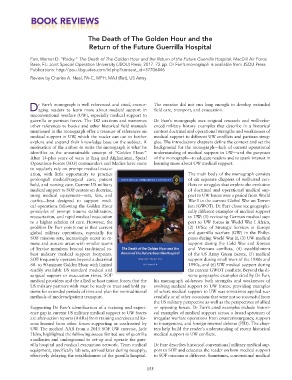
The Death of The Golden Hour and the
                                      Return of the Future Guerrilla Hospital

              Farr, Warner D. “Rocky.” The Death of The Golden Hour and the Return of the Future Guerrilla Hospital. MacDill Air Force
              Base, FL: Joint Special Operation University (JSOU) Press; 2017. 72 pp. Dr Farr’s monograph is available from JSOU Press
              Publications: http://jsou.libguides.com/ld.php?content_id=37706446
              Review by Charles A. Neal, PA-C, MPH, MAJ (Ret), US Army


                 r Farr’s monograph is well referenced and cited, encour-  The exercise did not run long enough to develop extended
             Daging readers to learn more about medical support in   field care, transport, and evacuation.
              unconventional warfare (UW), especially medical support to
              guerrilla or partisan forces. The 182 citations and numerous   Dr Farr’s monograph uses original research and well-refer-
              other references to books and other historical field manuals   enced military history examples that describe in a historical
              mentioned in the monograph offer a treasure of references on   context doctrinal and operational strengths and weaknesses of
              medical support in UW, which the reader can use to further   medical support to different UW conflicts and partisan strug-
              explore and expand their knowledge base on the subject. A   gles. The introductory chapters define the context and set the
              motivation of the author to write the monograph is what he   background for the monograph—lack of current operational
              identifies as the unsustainable concept of “Golden Hour.”   understanding of medical support in UW—and the purposes
              After 14-plus years of wars in Iraq and Afghanistan, Speial   of the monograph—to educate readers and to spark interest in
              Operations Forces (SOF) commanders and Medics have come   learning more about UW medical support.
              to regularly rely on prompt medical evacu-
              ation, with little opportunity to practice                       The main body of the monograph consists
              prolonged medical/surgical care, patient                         of  six separate  chapters  of  well-cited  con-
              hold, and nursing care. Current US military                      flicts or struggles that explore the evolution
              medical support to SOF centers on doctrine,                      of doctrinal and operational medical sup-
              using medical  equipment—sets,  kits,  and                       port to UW forces over a period from World
              outfits—best designed to support medi-                           War I to the current Global War on Terror-
              cal operations following the Golden Hour                         ism (GWOT). Dr Farr chose six geographi-
              principles of prompt trauma stabilization,                       cally different examples of medical support
              resuscitation, and rapid medical evacuation                      to UW: (1) reviewing German medical sup-
              to a higher echelon of care. However, the                        port to UW forces in World War I Africa,
              problem Dr Farr points out is that current                       (2) Office of Strategic Services in Europe
              global military operations, especially for                       and guerrilla warfare (GW) in the Philip-
              SOF mission sets, increasingly occur in re-                      pines during World War II, (3) UW medical
              mote and austere areas with smaller teams                        support during the Cold War and Korean
              of Service members beyond traditional ro-                        and Vietnam conflicts, (4) establishment
              bust military medical support footprints.                        of the US Army Green Berets, (5) medical
              SOF frequently operates beyond a doctrinal                       support during small wars of the 1980s and
              60- to 90-minute Golden Hour with limited                        1990s, and (6) UW medical support during
              readily available US standard medical and                        the current GWOT conflicts. Beyond the di-
              surgical support or evacuation times. SOF                        verse geographic examples cited by Dr Farr,
              medical providers and the allied or host nation forces that the   his monograph addresses both strengths and weaknesses of
              US military partners with must be ready to treat and hold pa-  evolving medical support to UW forces, providing examples
              tients for extended periods of time and plan for nontraditional   of where medical support to UW was sometimes applied suc-
              methods of medevac/patient transport.              cessfully or of other occasions that were not so successful from
                                                                 the US military perspective as well as the perspectives of allied
              Supporting Dr Farr’s identification of a training and experi-  or opposing forces. Dr Farr’s cited examples include histori-
              ence gap in current US military medical support to UW forces   cal examples of medical support across a broad spectrum of
              are after-action reports (AARs) from training exercises and les-  irregular warfare operations from counterinsurgency, support
              sons learned from other forces supporting or confronted by   to insurgencies, and foreign internal defense (FID). The chap-
              UW. The medical AAR from a 2015 SOF UW exercise, Jade   ters help build the reader’s understanding of recent historical
              Helm, highlighted the following issues: limited use of guerrilla   medical support in UW conflicts.
              auxiliaries and underground to set-up and operate the guer-
              rilla hospital and medical evacuation network. Team medical   Dr Farr describes historical conventional military medical sup-
              equipment, specifically lab sets, arrived later during resupply;   port to SOF and educates the reader on how medical support
              effectively delaying the establishment of the guerilla hospital.   to SOF missions is different. Sometimes, conventional medical

                                                              155

