


Page 140 - JSOM Spring 2018
P. 140
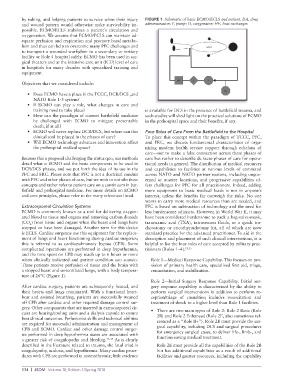
by tubing, and helping patients to survive when their injury   FIGURE 1  Schematic of basic ECMO/ECLS and patient. DA, drug
          and wound pattern would otherwise make survivability im-  administration; P, pump; O, oxygenator; HE, heat exchanger.
          possible.  ECMO/ECLS  stabilizes  a  patient´s  circulation  and
          oxygenation. We assume that ECMO/ECLS can maintain ad-
          equate perfusion and respiration and promote basal metabo-
          lism and thus can help to overcome many PFC challenges and
          to transport a wounded warfighter to a secondary or tertiary
          facility or Role 4 hospital safely. ECMO has been used in sur-
          gical theaters and at the intensive care unit (ICU) level of care
          in hospitals for many decades with specialized training and
          equipment.

          Objectives that we considered include:

            •  Does ECMO have a place in the TCCC, DCR/DCS ,and
               NATO Role 1-3 system?
            •  If ECMO can play a role, what changes in care and
               training need to take place?                  is available for DCS in the presence of battlefield trauma, and
            •  How can the paradigm of current battlefield medicine   such studies will shed light on the practical solutions of ECMO
               be challenged with ECMO to mitigate preventable   in the prehospital space and their benefits, if any.
               death, if at all?
            •  ECMO will never replace DCR/DCS, but where can this   Four Roles of Care From the Battlefield to the Hospital
               clinical tool be placed in the phases of care?  To place this concept within the paradigm of TCCC, PFC,
            •  Will ECMO technology advances and innovation affect   and FRC, we discuss fundamental characteristics of orga-
               the prehospital medical space?                nizing modern health service support through echelons of
                                                             care—not to make a false connection across these phases of
          Because this a proposal challenging the status quo, our methods   care but rather to describe de facto phases of care for opera-
          detail what is ECMO and the basic components to be used in   tional needs in general. The distribution of medical resources
          DCR/DCS phases, and we put forth the idea of its use in the   and  capabilities  to  facilities  at  various  levels  of  command
          PFC and FRC. Please note that PFC is not a doctrinal conduit   across NATO and NATO partner nations, including ungov-
          with PFC and other phases of care, but we wish to not silo these   erned or austere locations, and progressive capabilities of-
          concepts and rather refer to patient care on a continuum in bat-  fers challenges for PFC for all practitioners. Indeed, adding
          tlefield and prehospital medicine. For more details on ECMO   more equipment  to  basic  medical  loads is  not  in  anyone’s
          and core principles, please refer to the many references listed.  interest, unless the benefits far outweigh the risks. No one
                                                             wants to carry more medical resources than are needed, and
          Extracorporeal Circulation Systems                 PFC is based on subtraction of technology and the need for
          ECMO is commonly known as a tool for delivering oxygen-  less burdensome adjuncts. However, in World War II, it may
          ated blood to tissue and organs and removing carbon dioxide   have been considered burdensome to pack a bag-valve-mask,
          (CO ) from tissue and organs when the heart and lungs have   tranexamic  acid  (TXA),  intravenous  fluids,  or  a  quick  tra-
             2
          stopped or have been damaged. Another term for this device   cheostomy  or  cricothyroidotomy  kit,  all  of  which  are  now
          is ECLS. Cardiac surgeons use this equipment for the replace-  standard practice for the advanced practitioner. To aid in the
          ment of lungs and heart functioning during cardiac surgeries;   description and placement of such clinical interventions, it is
          this is referred to as cardiopulmonary bypass (CPB). Some   helpful to list the four roles of care accepted by military prac-
          complicated operations are performed in deep hypothermia,   titioners (Roles 1–4). 14,15
          and the time spent on CPB may reach up to 6 hours or more
          when clinically indicated and patient condition can sustain.   Role 1—Medical Response Capability. This focuses on pro-
          These patients receive perfusion of tissue and the brain with   vision of primary health care, specialized first aid, triage,
          a stopped heart and unventilated lungs, with a body tempera-  resuscitation, and stabilization.
          ture of 26°C (Figure 1).
                                                               Role 2—Initial Surgery Response Capability. Initial sur-
          After cardiac surgery, patients are subsequently heated, and   gery response capability is characterized by the ability to
          their hearts  and lungs reanimated.  With a functional  heart-  perform surgical interventions in addition to perform re-
          beat and assisted breathing, patients are successfully weaned   ception/triage of casualties; includes resuscitation and
          off CPB after cardiac and other required damage control sur-  treatment of shock to a higher level than Role 1 facilities.
          gery. Other components that are inserted in extracorporeal cir-
          cuits are heating/cooling units and a dialysis capsule to ensure   •  There are two main types of Role 2: Role 2 Basic (Role
          best clinical outcomes. Perfusionist skills and technical abilities   2B) and Role 2 Enhanced (Role 2E, also sometimes ref-
          are required for successful administration and management of   erenced as a “Role II+”). Role 2B must provide the sur-
          CPB and ECMO. Cardiac and other damage control surger-  gical capability, including DCS and surgical procedures
          ies performed in deep hypothermia states are associated with   for emergency surgical cases, to deliver life-, limb-, and
          a greater risk of coagulopathy and bleeding. 11–13  As is clearly   function-saving medical treatment.
          described in the literature related to trauma, the fatal triad is   Role 2E must provide all the capabilities of the Role 2B
          coagulopathy, acidosis, and hypothermia. Many cardiac proce-  but has additional capabilities as a result of additional
          dures with CPB are performed in normothermia; little evidence   facilities and greater resources, including the capability


          134  |  JSOM   Volume 18, Edition 1/Spring 2018

