


Page 61 - Journal of Special Operations Medicine - Spring 2017
P. 61
were able to have a tourniquet removed or to stop par-  Statistical Analysis
              ticipating at any time.                            Numeric  time  and  pressure  data  were  organized  in
                                                                 Microsoft Office Excel 2003 (Microsoft Corp; www
              Protocol                                           .microsoft.com). Doppler versus pulse oximeter Signal
                1.  Recipient age, limb circumference, and blood pres-  Gones time and pressure data were analyzed using re-
                 sure information was collected.                 peated measures multivariate analysis of variance with
                2.  Recipients lay down throughout each application,   Tukey–Kramer post hoc tests.
                 with foam support and mid-range flexion of the rel-
                 evant limb.                                     Contingency data were analyzed using χ  tests for Dop-
                                                                                                   2
                3.  Recipients were directed to maintain the relevant   pler versus each pulse oximeter at every second from
                 limb in a completely relaxed state.             1) the first Signal Gone to the last Signal Return and 2)
                4.  Sensor placements were established for a clear, au-  from the first Doppler Signal Gone to tourniquet release
                 dible Doppler pulse signal and for pulsatile pulse   via release of the ratcheting buckle. Contingency data
                 oximeter waveforms.                             were also analyzed using χ  tests for Doppler versus each
                                                                                       2
                5.  Tourniquets were applied directly on skin, with the   pulse oximeter at every discrete 1mmHg interval from
                 friction buckle on the lateral aspect of each limb   the first Doppler Signal Gone to tourniquet release. The
                 and the free end of the strap pulled downward   time points and pressure points from the first Doppler
                 through the friction buckle.                    Signal  Gone  to tourniquet  release  were  deemed  to  be
                6.  The limb order of use was left mid-thigh, left mid-  the more relevant for evaluating the potential usefulness
                 upper arm, right mid-thigh, right mid-upper arm,   of a pulse oximeter for field monitoring of tourniquet
                 with each entire iteration taking approximately 9   effectiveness because release would not be expected to
                 minutes.                                        occur until definitive care of the injury was occurring.
                7.  After achieving friction-pressure, the tourniquet was
                 tightened via advancement of the ratcheting buckle   Graphing and statistical analyses were performed with
                 a single ladder tooth at a time just until the Dop-  GraphPad Prism version 5.02 for Windows (GraphPad
                 pler signal was gone. (This degree of tightening was   Software Inc; www.graphpad.com). Statistical signifi-
                 to increase the probability that the Doppler signal   cance was set at p ≤ .05.
                 would return at least once during most tourniquet
                 applications.)
                8.  After a 10-second pause, the pulse oximeter raters   Results
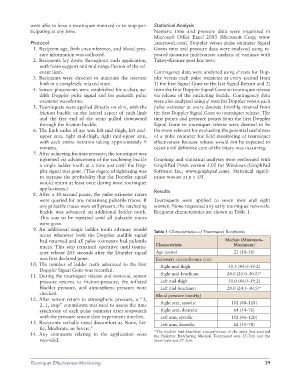
                 were queried for any remaining pulsatile traces. If   Tourniquets  were  applied  to  seven  men  and  eight
                 any pulsatile traces were still present, the ratcheting   women. None requested any early tourniquet removals.
                 buckle was advanced an additional ladder tooth.   Recipient characteristics are shown in Table 1.
                 This was to be repeated until all pulsatile traces
                 were gone.
                9.  An additional single ladder tooth advance would   Table 1 Characteristics of Tourniquet Recipients
                 occur whenever both the Doppler audible signal
                 had returned and all pulse oximeters had pulsatile                           Median (Minimum–
                 traces. This step remained operative until tourni-  Characteristic              Maximum)
                 quet release 205 seconds after the Doppler signal   Age (years)                  21 (18–56)
                 was first declared gone.                        Extremity circumference (cm)
              10.  The number of ladder teeth advanced to the first     Right mid-thigh        50.5 (44.0–59.2)
                 Doppler Signal Gone was recorded.
              11.  During the tourniquet release and removal, sensor     Right mid-brachium    28.0 (25.0–30.0)*
                 pressure returns to friction-pressure, the inflated     Left mid-thigh        51.0 (44.0–59.2)
                 bladder  pressure,  and  atmospheric  pressure  were     Left mid-brachium    29.0 (24.5–30.5)*
                 checked.                                        Blood pressure (mmHg)
              12.  After sensor return to atmospheric pressure, a “3,
                 2, 1, stop” countdown was used to assess the time     Right arm, systolic       102 (88–118)
                 synchrony of each pulse oximeter rater stopwatch     Right arm, diastolic        64 (54–76)
                 with the pressure sensor data experiment timeline.    Left arm, systolic        102 (86–120)
              13.  Recipients verbally rated discomfort as None, Lit-    Left arm, diastolic      62 (50–78)
                 tle, Moderate, or Severe. 8
              14.  Any comments relating to the application were   *The median mid-brachium circumference of the arms that received
                                                                 the Pediatric Ratcheting Medical Tourniquet was 25.7cm and the
                 recorded.                                       maximum was 27.3cm.


              Tourniquet Effectiveness Monitoring                                                             39

