


Page 65 - Journal of Special Operations Medicine - Spring 2017
P. 65
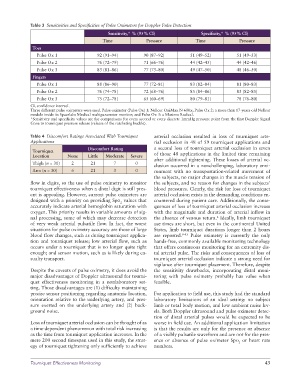
Table 3  Sensitivities and Specificities of Pulse Oximeters for Doppler Pulse Detection
                                              Sensitivity,* % (95% CI)              Specificity,* % (95% CI)
                                           Time              Pressure             Time              Pressure
              Toes
                Pulse Ox 1               92 (91–94)         90 (87–92)          51 (49–52)         51 (49–53)
                Pulse Ox 2               76 (72–79)         71 (66–76)          44 (42–45)         44 (42–46)
                Pulse Ox 3               83 (81–86)         77 (73–80)          49 (47–50)         48 (46–50)
              Fingers
                Pulse Ox 1               88 (86–90)         77 (72–81)          83 (82–84)         81 (80–83)
                Pulse Ox 2               76 (74–78)         72 (68–76)          85 (84–86)         83 (82–85)
                Pulse Ox 3               75 (72–78)         65 (60–69)          80 (79–81)         78 (76–80)
              CI, confidence interval.
              Three different pulse oximeters were used. Pulse oximeter (Pulse Ox) 1: Nellcor OxiMax N-600x; Pulse Ox 2: a more than 17-years-old Nellcor
              module inside its Spacelabs Medical multiparameter monitor; and Pulse Ox 3: a Masimo Radical.
              *Sensitivity and specificity values are for comparisons for every second or every discrete 1mmHg pressure point from the first Doppler Signal
              Gone to tourniquet pressure release (release of the ratcheting buckle).

              Table 4  Discomfort Ratings Associated With Tourniquet   arterial  occlusion  resulted  in  loss  of  tourniquet  arte-
              Applications                                       rial occlusion in 48 of 59 tourniquet applications and
                                     Discomfort Rating           a second loss of tourniquet arterial occlusion in seven
              Tourniquet                                         of those 48 applications in the limited time remaining
              Location       None    Little  Moderate  Severe
                                                                 after additional tightening. These losses of arterial oc-
              Thigh (n = 30)   2      21        7        0
                                                                 clusion occurred in a nonchallenging, laboratory envi-
              Arm (n = 30)     6      21        3        0       ronment with no transportation-related movement of
                                                                 the subjects, no major changes in the muscle tension of
              flow in digits, so the use of pulse oximetry to monitor   the subjects, and no reason for changes in the subjects’
              tourniquet effectiveness when a distal digit is still pres-  blood pressures. Clearly, the risk for loss of tourniquet
              ent is appealing. However, current pulse oximeters are   arterial occlusion exists in the demanding conditions en-
              designed with a priority on providing Spo  values that   countered during patient care. Additionally, the conse-
                                                   2
              accurately indicate arterial hemoglobin saturation with   quences of loss of tourniquet arterial occlusion increase
              oxygen. This priority results in variable amounts of sig-  with the magnitude and duration of arterial inflow in
              nal processing, some of which may decrease detection   the absence of venous return.  Ideally, limb tourniquet
                                                                                           2
              of very weak arterial pulsatile flow. In fact, the worst   use times are short, but even in the continental United
              situations for pulse oximetry accuracy are those of large   States, limb tourniquet durations longer than 2 hours
              blood flow changes, such as during tourniquet applica-  are reported. 9–13  Pulse oximetry is currently the only
              tion and tourniquet release; low arterial flow, such as   hands-free, commonly available monitoring technology
              occurs under a tourniquet that is no longer quite tight   that offers continuous monitoring for an extremity dis-
              enough; and sensor motion, such as is likely during ca-  tal arterial pulse. The risks and consequences of loss of
              sualty transport.                                  tourniquet arterial occlusion indicate a strong need for
                                                                 vigilance after tourniquet placement. Therefore, despite
              Despite the caveats of pulse oximetry, it does avoid the   the sensitivity drawbacks, incorporating distal moni-
              major disadvantages of Doppler ultrasound for tourni-  toring  with  pulse  oximetry  probably  has  value  when
              quet effectiveness monitoring in a nonlaboratory set-  feasible.
              ting. Those disadvantages are (1) difficulty maintaining
              precise sensor positioning regarding anatomic location,   For application to field use, this study had the standard
              orientation relative to the underlying artery, and pres-  laboratory limitations of an ideal  setting:  no subject
              sure  exerted  on  the  underlying  artery  and  (2)  back-  limb or total body motion, and low ambient noise lev-
              ground noise.                                      els. Both Doppler ultrasound and pulse oximeter detec-
                                                                 tion of distal arterial pulses would be expected to be
              Loss of tourniquet arterial occlusion can be thought of as   worse in field use. An additional application limitation
              a time-dependent phenomenon with total risk increasing   is that the results are only for the presence or absence
              as the time from tourniquet application increases. In the   of a visibly pulsatile waveform and are not for the pres-
              mere 200 second timespan used in this study, the strat-  ence or absence of pulse oximeter Spo  or heart rate
                                                                                                    2
              egy of tourniquet tightening only  sufficiently to achieve   numbers.


              Tourniquet Effectiveness Monitoring                                                             43

