


Page 64 - Journal of Special Operations Medicine - Spring 2017
P. 64
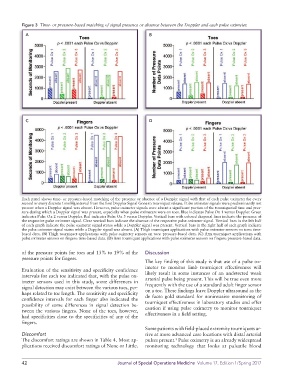
Figure 3  Time- or pressure-based matching of signal presence or absence between the Doppler and each pulse oximeter.
            A                                                  B


            C                                                  D


          Each panel shows time- or pressure-based matching of the presence or absence of a Doppler signal with that of each pulse oximeter for every
          second or every discrete 1mmHg interval from the first Doppler Signal Gone to tourniquet release. Pulse oximeter signals were predominantly not
          present when a Doppler signal was absent. However, pulse oximeter signals were absent a significant portion of the tourniqueted time and pres-
          sure during which a Doppler signal was present, especially when pulse oximeters were on toes. Blue indicates Pulse Ox 1 versus Doppler. Green
          indicates Pulse Ox 2 versus Doppler. Red indicates Pulse Ox 3 versus Doppler. Vertical bars with colored diagonal lines indicate the presence of
          the respective pulse oximeter signal. Clear vertical bars indicate the absence of the respective pulse oximeter signal. Vertical bars in the left half
          of each graph indicate the pulse oximeter signal status while a Doppler signal was present. Vertical bars in the right half of each graph indicate
          the pulse oximeter signal status while a Doppler signal was absent. (A) Thigh tourniquet applications with pulse oximeter sensors on toes: time-
          based data. (B) Thigh tourniquet applications with pulse oximeter sensors on toes: pressure-based data. (C) Arm tourniquet applications with
          pulse oximeter sensors on fingers: time-based data. (D) Arm tourniquet applications with pulse oximeter sensors on fingers: pressure-based data.

          of the pressure points for toes and 13% to 19% of the   Discussion
          pressure points for fingers.
                                                             The key finding of this study is that use of a pulse ox-
                                                             imeter  to  monitor  limb tourniquet  effectiveness  will
          Evaluation of the sensitivity and specificity confidence   likely  result  in  some  instances  of  an undetected  weak
          intervals for each toe indicated that, with the pulse ox-  arterial pulse being present. This will be true even more
          imeter sensors used in this study, some differences in   frequently with the use of a standard adult finger sensor
          signal detection may exist between the various toes, per-  on a toe. These findings leave Doppler ultrasound as the
          haps related to toe length. The sensitivity and specificity   de facto gold standard for noninvasive monitoring of
          confidence  intervals  for  each  finger  also  indicated  the   tourniquet effectiveness in laboratory studies and offer
          possibility of some differences in signal detection be-  caution if using pulse oximetry to monitor tourniquet
          tween the various fingers. None of the toes, however,   effectiveness in a field setting.
          had specificities close to the specificities of any of the
          fingers.
                                                             Some patients with field-placed extremity tourniquets ar-
          Discomfort                                         rive at more advanced care locations with distal arterial
          The discomfort ratings are shown in Table 4. Most ap-  pulses present.  Pulse oximetry is an already widespread
                                                                          3
          plications received discomfort ratings of None or Little.  monitoring technology that looks at pulsatile blood


          42                                      Journal of Special Operations Medicine  Volume 17, Edition 1/Spring 2017

