


Page 122 - Journal of Special Operations Medicine - Winter 2016
P. 122
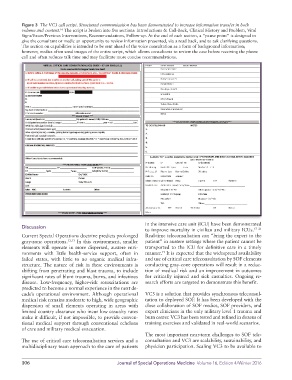
Figure 3  The VC3 call script. Structured communication has been demonstrated to increase information transfer in both
                          16
          volume and content.  The script is broken into five sections: Introductions & Call-Back, Clinical History and Problem, Vital
          Signs/Exam/Previous Interventions, Recommendations, Follow-up. At the end of each section, a “pause point” is designed to
          give the consultant or medic an opportunity to review information presented, via a read back, and to ask clarifying questions.
          The section on capabilities is intended to be sent ahead of the voice consultation as a form of background information;
          however, medics often send images of the entire script, which allows consultants to review the case before receiving the phone
          call and often reduces talk time and may facilitate more concise recommendations.


                                                             in the intensive care unit (ICU) have been demonstrated
          Discussion
                                                             to improve mortality in civilian and military ICUs. 17–21
          Current Special Operations doctrine predicts prolonged   Real-time teleconsultation can “bring the expert to the
          gray-zone operations. 12,13  In this environment, smaller   patient” in austere settings where the patient cannot be
          elements will operate in more dispersed, austere envi-  transported  to the ICU  for definitive  care in a timely
          ronments with little health-service support, often in   manner.  It is expected that the widespread availability
                                                                    19
          failed states, with little to no organic medical infra-  and use of critical care teleconsultation by SOF elements
          structure.  The  nature  of  risk  in these  environments  is   conducting gray-zone operations will result in a reduc-
          shifting from penetrating and blast trauma, to include   tion of medical risk and an improvement in outcomes
          significant rates of blunt trauma, burns, and infectious   for critically injured and sick casualties. Ongoing re-
          disease. Low-frequency, higher-risk resuscitations are   search efforts are targeted to demonstrate this benefit.
          predicted to become a normal experience in the next de-
          cade’s operational environment. Although operational   VC3 is a solution that provides synchronous teleconsul-
          medical risk remains moderate to high, wide geographic   tation to deployed SOF. It has been developed with the
          dispersion of small elements operating in areas with   close collaboration of SOF medics, SOF providers, and
          limited country clearance who incur low casualty rates   expert clinicians in the only military level 1 trauma and
          make it difficult, if not impossible, to provide conven-  burn center. VC3 has been tested and refined in dozens of
          tional medical support through conventional echelons   training exercises and validated in real-world scenarios.
          of care and military medical evacuation.
                                                             The most important near-term challenges to SOF tele-
          The use of critical care teleconsultation services and a   consultation and VC3 are scalability, sustainability, and
          multidisciplinary team approach to the care of patients   physician participation. Scaling VC3 to be available to


          106                                    Journal of Special Operations Medicine  Volume 16, Edition 4/Winter 2016

