


Page 119 - Journal of Special Operations Medicine - Winter 2016
P. 119
PFC: Tactical Solutions for Austere,               Figure 2  Consultations placed to the Army Medical
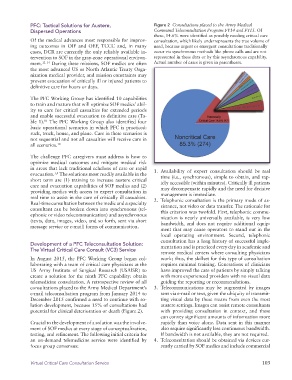
              Dispersed Operations                               Command Teleconsultation Program FY14 and FY15. Of
                                                                 these, 14.6% were identified as possibly needing critical care
              Of the medical advances most responsible for improv-  consultation, which likely underrepresents the true volume of
              ing outcomes in OIF and OEF, TCCC and, in many     need, because urgent or emergent consultations traditionally
              cases, DCR are currently the only reliably available in-  occur via synchronous methods like phone calls and are not
              tervention to SOF in the gray-zone operational environ-  represented in these data or by this asynchronous capability.
              ment. 12–14  During these missions, SOF medics are often   Actual number of cases is given in parentheses.
              the most advanced US or North Atlantic Treaty Orga-
              nization medical provider, and mission constraints may
              prevent evacuation of critically ill or injured patients to
              definitive care for hours or days.

              The PFC Working Group has identified 10 capabilities
              to train and mature that will optimize SOF medics’ abil-
              ity to care for critical casualties for extended periods
              and enable successful evacuation to definitive care (Ta-
                   11
              ble 1).  The PFC Working Group also identified four
              basic operational scenarios in which PFC is practiced:
              ruck, truck, house, and plane. Care in these scenarios is
              not sequential and not all casualties will receive care in
              all scenarios. 10

              The challenge PFC caregivers must address is how to
              optimize medical outcomes and mitigate medical risk
              in areas that lack traditional echelons of care or rapid   1.  Availability of expert consultation should be real
              evacuation.  The solutions most readily available in the   time (i.e., synchronous), simple to obtain, and rap-
                       1,9
              short term are (1) training to increase austere critical   idly accessible (within minutes). Critically ill patients
              care and evacuation capabilities of SOF medics and (2)   may decompensate rapidly and the need for decisive
              providing medics with access to expert consultation in   management is immediate.
              real time to assist in the care of critically ill casualties.   2.  Telephonic consultation is the primary mode of as-
              Real-time consultation between the medic and a specialty   sistance, not video or data transfer. The rationale for
              consultant can be broken down into synchronous (tel-  this criterion was twofold. First, telephonic commu-
              ephonic or video telecommunication) and asynchronous   nication is nearly universally available, is very low
              (texts, data, images, video, and so forth, sent via short   bandwidth, and does not require additional equip-
              message service or e-mail) forms of communication.
                                                                   ment that may cause operators to stand out in the
                                                                   local operating environment. Second, telephonic
                                                                   consultation has a long history of successful imple-
              Development of a PFC Teleconsultation Solution:      mentation and is practiced every day in academic and
              The Virtual Critical Care Consult (VC3) Service
                                                                   remote medical centers where consulting physicians
              In  August  2015,  the  PFC  Working  Group  began  col-  work; thus, the skillset for this type of consultation
              laborating with a team of critical care physicians at the   requires minimal training. Generations of clinicians
              US Army Institute of Surgical Research (USAISR) to   have improved the care of patients by simply talking
              create a solution for the ninth PFC capability: obtain   with more experienced providers with no visual data
              telemedicine consultation. A retrospective review of all   guiding the reporting or recommendations.
              consultations placed to the Army Medical Department’s   3.  Telecommunications may be augmented by images
              e-mail teleconsultation program from January 2014 to   sent via e-mail or text, given the ubiquity of transmit-
              December 2015 confirmed a need to continue with so-  ting visual data by these means from even the most
              lution development, because 15% of consultations had   austere settings. Images can assist remote consultants
              potential for clinical deterioration or death (Figure 2).  with  providing  consultation  in  context,  and  these
                                                                   can convey significant amounts of information more
              Crucial to the development of a solution was the involve-  rapidly than voice alone. Data sent in this manner
              ment of SOF medics at every stage of conceptualization,   also require significantly less continuous bandwidth.
              testing, and refinement. The following initial criteria for   If bandwidth is not available, they are not required.
              an on-demand telemedicine service were identified by   4.  Teleconsultation should be obtained via devices cur-
              focus group consensus:                               rently carried by SOF medics and include commercial


              Virtual Critical Care Consultation Service                                                     103

