


Page 118 - Journal of Special Operations Medicine - Winter 2016
P. 118
Telemedicine to Reduce Medical Risk
                                   in Austere Medical Environments

                           The Virtual Critical Care Consultation (VC3) Service


             Doug Powell, MD; Robert D. McLeroy, MD; Jamie Riesberg, MD; William Vasios, MPAS;
                Ethan Miles, MD; Jeffrey Dellavolpe, MD; Sean Keenan, MD; Jeremy Pamplin, MD


          ABSTRACT

          One of the core capabilities of prolonged field care is tele-  surgery, hemostatic (whole-blood or matched-component
          medicine. We developed the Virtual Critical Care Consult   therapy) blood-product resuscitation, Joint Trauma Sys-
          (VC3) Service to provide Special Operations Forces (SOF)   tem management guidelines, and critical care casualty
          medics with on-demand, virtual consultation with expe-  transportation, all require advanced medical capabilities
          rienced critical care physicians to optimize management   and significant logistical support. Constrained geography
          and improve outcomes of complicated, critically injured   and recognition that outcomes improved when casualties
          or ill patients. Intensive-care doctors staff VC3 continu-  received rapid, definitive, surgical resuscitative care led
          ously. SOF medics access this service via phone or e-mail.   to the development of increasingly more robust medical
          A single phone  call reaches  an intensivist immediately.   evacuation capabilities in OIF and OEF.  As the military
                                                                                               8
          An e-mail distribution list is used to share information   transitions from operating environments with mature
          such as casualty images, vital signs flowsheet data, and   medical and evacuation resources to more resource-lim-
          short video clips, and helps maintain situational aware-  ited operations, a shift in medical capabilities is neces-
          ness among the VC3 critical care providers and other   sary because advanced trauma care from combat support
          key SOF medical leaders. This real-time support enables   hospitals (CSHs) and forward surgical teams (FSTs) is
          direct communication between the remote provider and   unlikely to be available within the “golden hour,” if at
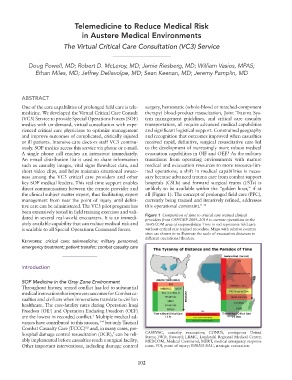
          the clinical subject matter expert, thus facilitating expert   all (Figure 1). The concept of prolonged field care (PFC),
          management from near the point of injury until defini-  currently being trained and iteratively refined, addresses
          tive care can be administered. The VC3 pilot program has   this operational constraint. 9–11
          been extensively tested in field training exercises and vali-
          dated in several real-world encounters. It is an immedi-  Figure 1  Comparison of time to critical care trained clinical
                                                             providers from OIF/OEF 2009–2014 to current operations in the
          ately available capability that can reduce medical risk and   AFRICOM area of responsibility. Time in red represents field care
          is scalable to all Special Operations Command forces.  without critical care trained providers. Maps with relative country
                                                             sizes are shown to to illustrate the scale of evacuation distances in
                                                             different operational theaters.
          Keywords:  critical care; telemedicine; military personnel;
          emergency treatment; patient transfer; combat casualty care


          Introduction


          SOF Medicine in the Gray Zone Environment
          Throughout history, armed conflict has led to substantial
          medical innovation that improves outcomes for Combat ca-
          sualties and civilians when innovations translate to civilian
          healthcare. The case-fatality rates during Operation Iraqi
          Freedom (OIF) and Operation Enduring Freedom (OEF)
          are the lowest in recorded conflict.  Multiple medical ad-
                                       1
          vances have contributed to this success,  but only Tactical
                                          1–4
          Combat Casualty Care (TCCC)  and, in many cases, pre-
                                    5,6
          hospital damage control resuscitation (DCR),  can be reli-  CASEVAC, casualty evacuation; CONUS, contiguous United
                                                7
                                                             States; FWD, forward; LRMC, Landstuhl Regional Medical Center;
          ably implemented before casualties reach a surgical facility.     MEDCOM, Medical Command; MERT, medical emergency response
          Other important interventions, including damage control   team; POI, point of injury; STRATEVAC, strategic evacuation.
                                                          102

