


Page 113 - Journal of Special Operations Medicine - Winter 2016
P. 113
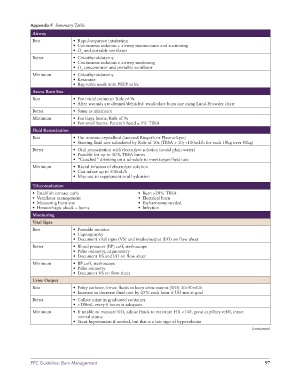
Appendix F  Summary Table
              Airway
              Best             •  Rapid-sequence intubation
                               •  Continuous sedation + airway maintenance and suctioning
                               •  O  and portable ventilator
                                   2
              Better           •  Cricothyroidotomy
                               •  Continuous sedation + airway suctioning
                               •  O  concentrator and portable ventilator
                                   2
              Minimum          •  Cricothyroidotomy
                               •  Ketamine
                               •  Bag-valve mask with PEEP valve
              Assess Burn Size
              Best             •  For initial estimate: Rule of 9s
                               •  After wounds are cleaned/debrided: recalculate burn size using Lund-Browder chart
              Better           •  Same as minimum
              Minimum          •  For large burns: Rule of 9s
                               •  For small burns: Patient’s hand = 1% TBSA
              Fluid Resuscitation
              Best             •  Use isotonic crystalloid (lactated Ringer’s or Plasma-Lyte)
                               •  Starting fluid rate calculated by Rule of 10s (TBSA × 10; +100mL/h for each 10kg over 80kg)
              Better           •  Oral resuscitation with electrolyte solution (avoid plain water)
                               •  Possible for up to 30% TBSA burns
                               •  “Coached” drinking on a schedule to meet target fluid rate
              Minimum          •  Rectal infusion of electrolyte solution
                               •  Can infuse up to 500mL/h
                               •  May use to supplement oral hydration
              Teleconsultation
              •  Establish contact early                  •  Burn >20% TBSA
              •  Ventilator management                    •  Electrical burn
              •  Measuring burn size                      •  Escharotomy needed
              •  Hemorrhagic shock + burns                •  Infection
              Monitoring
              Vital Signs
              Best             •  Portable monitor
                               •  Capnography
                               •  Document vital signs (VS) and intake/output (I/O) on flow sheet
              Better           •  Blood pressure (BP) cuff, stethoscope
                               •  Pulse oximetry, capnometry
                               •  Document VS and I/O on flow sheet
              Minimum          •  BP cuff, stethoscope
                               •  Pulse oximetry
                               •  Document VS on flow sheet
              Urine Output
              Best             •  Foley catheter, titrate fluids to keep urine output (UO) 30–50mL/h
                               •  Increase or decrease fluid rate by 25% each hour if UO not at goal
              Better           •  Collect urine in graduated container
                               •  >180mL every 6 hours is adequate
              Minimum          •  If unable to measure UO, adjust fluids to maintain HR <140, good capillary refill, intact
                                 mental status
                               •  Treat hypotension if needed, but this is a late sign of hypovolemia
                                                                                                         (continues)


              PFC Guideline: Burn Management                                                                  97

