


Page 56 - Journal of Special Operations Medicine - Summer 2016
P. 56
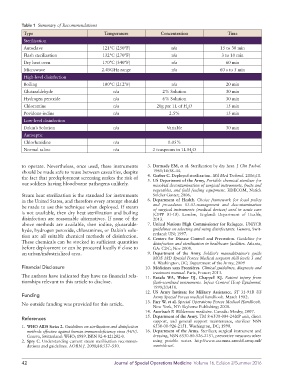
Table 1  Summary of Recommendations
           Type                             Temperature            Concentration               Time
           Sterilization
           Autoclave                       121°C (250°F)                n/a                 15 to 30 min
           Flash sterilization             132°C (270°F)                n/a                  3 to 10 min
           Dry heat oven                   170°C (340°F)                n/a                   60 min
           Microwave                       2.45GHz range                n/a                 60 s to 5 min
           High-level disinfection
           Boiling                         100°C (212°F)                n/a                   20 min
           Glutaraldehyde                       n/a                 2% Solution               30 min
           Hydrogen peroxide                    n/a                 6% Solution               30 min
           Chloramine                           n/a               20g per 1L of H O           15 min
                                                                              2
           Povidone-iodine                      n/a                    2.5%                   15 min
           Low-level disinfection
           Dakin’s Solution                     n/a                   Variable                30 min
           Antiseptic
           Chlorhexidine                        n/a                   0.05%
           Normal saline                        n/a             2 teaspoons in 1L H O
                                                                                2

          to  operate. Nevertheless, once used, these instruments     3.  Darmady EM, et al. Sterilization by dry heat. J Clin Pathol.
          should be made safe to reuse between casualties, despite   1961;14:38–44.
          the fact that predeployment screening makes the risk of     4.  Gerber C. Deployed sterilization. Mil Med Technol. 2006;10.
                                                               5.  US Department of the Army, Portable chemical sterilizer for
          our soldiers having bloodborne pathogens unlikely.    micobial decontamination of surgical instruments, fruits and
                                                                vegetables, and field feeding equipment. RDECOM, Natick
          Steam heat sterilization is the standard for instruments   Soldier Center; 2006.
          in the United States, and therefore every attempt should     6.  Department of Health.  Choice framework for local policy
          be made to use this technique when deployed. If steam   and  procedures  01-01-management and  decontamination
                                                                of surgical instruments (medical devices) used in acute care
          is not available, then dry heat sterilization and boiling   (CFPP 01-10). London, England: Department of Health;
          disinfection are reasonable alternatives. If none of the   2013.
          above methods are available, then iodine, glutaralde-    7.  United Nations High Commissioner for Refugees. UNHCR
          hyde, hydrogen peroxide, chloramines, or Dakin’s solu-  guidelines on selecting and using disinfectants. Geneva, Swit-
                                                                zerland: UN; 1997.
          tion are all suitable chemical methods of disinfection.     8.  Centers for Disease Control and Prevention.  Guideline for
          These chemicals can be stocked in sufficient quantities   disinfection and sterilization in healthcare facilities. Atlanta,
          before deployment or can be procured locally if close to   GA: CDC; Nov 2008.
          an urban/industrialized area.                        9.  Department of the Army.  Soldier’s manual/trainer’s guide
                                                                MOS 18D Special Forces Medical sergeant skill levels 3 and
                                                                4. Washington, DC; Department of the Army; 2009
          Financial Disclosure                               10.  Médicines sans Frontières. Clinical guidelines, diagnosis and
                                                                treatment manual. Paris, France; 2013.
          The authors have indicated they have no financial rela-  11.  Rutala WA, Weber DJ, Chappell KJ.  Patient injury from
          tionships relevant to this article to disclose.       flash-sterilized instruments. Infect Control Hosp Epidemiol.
                                                                1999;20:458.
                                                             12.  US Army Institute for Military Assistance.  ST 31-91B US
          Funding                                               Army Special Forces medical handbook. March 1982.
          No outside funding was provided for this article.  13.  Farr W, et al. Special Operations Forces Medical Handbook.
                                                                New York, NY: Skyhorse Publishing; 2008.
                                                             14.  Auerbach P. Wilderness medicine. Canada: Mosby; 2007.
          References                                         15.  Department of the Army. TM 8-6530-004-24&P unit, direct
                                                                support,  and  general  support  maintenance,  sterilizer  NSN
          1.  WHO AIDS Series 2. Guidelines on sterilization and disinfection   6530-00-926-2151. Washington, DC; 1990.
            methods effective against human immunodeficiency virus (HIV).   16.  Department of the Army. Sterilizer, surgical instrument and
            Geneva, Switzerland: WHO; 1989. ISBN 92-4-121202-0.  dressing, NSN 6530-00-926-2151, preventive measures when
          2.  Spry C. Understanding current steam sterilization recommen-  using  potable  water.  http://www.usamma.amedd.army.mil/
            dations and guidelines. AORN J. 2008;88:537–550.    assets/docs/.


          42                                    Journal of Special Operations Medicine  Volume 16, Edition 2/Summer 2016

