


Page 59 - Journal of Special Operations Medicine - Summer 2016
P. 59
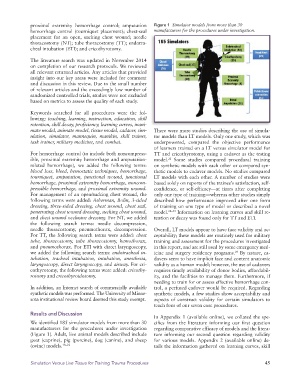
proximal  extremity  hemorrhage  control;  amputation   Figure 1  Simulator models from more than 30
              hemorrhage control (tourniquet placement); chest-seal   manufacturers for the procedures under investigation.
              placement for an open, sucking chest wound; needle
              thoracostomy (NT); tube thoracostomy (TT); endotra-
              cheal intubation (ETI); and cricothyrotomy.

              The literature search was updated in November 2014
              on completion of our research protocols. We reviewed
              all relevant returned articles. Any articles that provided
              insight into our key areas were included for comment
              and discussion in this review. Due to the small number
              of relevant articles and the exceedingly low number of
              randomized controlled trials, studies were not excluded
              based on metrics to assess the quality of each study.

              Keywords searched for all procedures were the fol-
              lowing: teaching, learning, instruction, education, skill
              retention, skill decay, proficiency, learning curves, inani-
              mate model, animate model, tissue model, cadaver, sim-  There were more studies describing the use of simula-
              ulation, simulator,  mannequin, manikin,  skill trainer,   tor models than LT models. Only one study, which was
              task trainer, military medicine, and combat.       underpowered, compared the objective performance
                                                                 of learners trained on a LT versus simulator model for
              For hemorrhage control (to include both noncompress-  TT and cricothyrotomy, using a cadaver as the testing
              ible, proximal extremity hemorrhage and amputation-  model.  Some studies compared procedural training
                                                                      23
              related hemorrhage), we added the following terms:   on synthetic models with each other or compared syn-
              blood loss, bleed, hemostatic techniques, hemorrhage,   thetic models to cadaver models. No studies compared
              tourniquet, amputation, junctional wound, junctional   LT models with each other. A number of studies were
              hemorrhage, proximal extremity hemorrhage, noncom-  based solely on reports of the trainee’s satisfaction, self-
              pressible hemorrhage, and proximal extremity wound.   confidence, or self-efficacy—at times after completing
              For management of an open/sucking chest wound, the   only one type of training—whereas other studies simply
              following terms were added: Asherman, Bolin, 3-sided   described  how  performance  improved  after  one  form
              dressing, three-sided dressing, chest wound, chest seal,   of training on one type of model or described a novel
              penetrating chest wound dressing, sucking chest wound,   model. 24–39  Information on learning curves and skill re-
              and chest wound occlusive dressing. For NT, we added   tention or decay was found only for TT and ETI.
              the following search terms: needle decompression,
              needle thoracostomy, pneumothorax, decompression.   Overall, LT models appear to have face validity and ac-
              For TT, the following search terms were added: chest   ceptability; these models are routinely used for military
              tube, thoracostomy, tube thoracostomy, hemothorax,   training and assessment for the procedures investigated
              and pneumothorax. For ETI with direct laryngoscopy,   in this report, and are still used by some emergency med-
              we added the following search terms: endotracheal in-  icine and surgery residency programs.  By nature, ca-
                                                                                                  29
              tubation, tracheal intubation, intubation, anesthesia,   davers seem to have implicit face and content anatomic
              laryngoscopy, direct laryngoscopy, and airway. For cri-  validity as a human model; however, the use of cadavers
              cothyrotomy, the following terms were added: cricothy-  requires timely availability of donor bodies, affordabil-
              rotomy and cricothyroidotomy.                      ity, and the facilities to manage them. Furthermore, if
                                                                 needing to train for or assess effective hemorrhage con-
              In addition, an Internet search of commercially available   trol, a perfused cadaver would be required. Regarding
              synthetic models was performed. The University of Minne-  synthetic models, a few studies show acceptability and
              sota institutional review board deemed this study exempt.  aspects of construct validity for certain simulators to
                                                                 teach four of our seven core procedures.
              Results and Discussion
                                                                 In Appendix 1 (available online), we collated the spe-
              We identified 185 simulator models from more than 30   cifics from the literature informing our first question
              manufacturers for the procedures under investigation   regarding comparative efficacy of models and the litera-
              (Figure 1). Adult, live animal models described include   ture informing our second question regarding validity
              goat (caprine), pig (porcine), dog (canine), and sheep   for various models. Appendix 2 (available online) de-
              (ovine) models. 18–22                              tails the information gathered on learning curves, skill


              Simulation Versus Live Tissue for Training Trauma Procedures                                    45

