


Page 61 - Journal of Special Operations Medicine - Summer 2016
P. 61
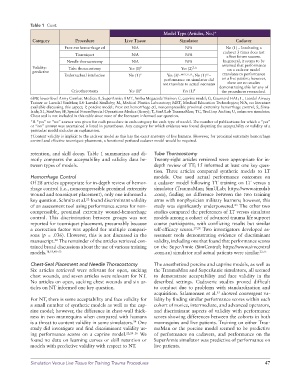
Table 1  Cont.
                                                                     Model Type (Articles, No.)*
              Category          Procedure           Live Tissue            Simulator              Cadaver
                            Prox ext hemorrhage ctl    N/A                    N/A             No (1) – Intubating a
                                                                                             cadaver 3 times does not
                                Tourniquet             N/A                    N/A              affect future success.
                             Needle thoracostomy       N/A                    N/A            In general, it seems to be
              Validity:      Tube thoracostomy        Yes (1) P             Yes (2) T, A     assumed that performance
                                                                                               on a cadaver model
              predictive
                            Endotracheal intubation   No (1)  P       Yes (3) L, MET, G, S1 ; No (1) –   translates to performance
                                                                                      LS
                                                                     performance on simulator did   on a live patient; however,
                                                                    not translate to actual neonates  there are no studies
                                                                                            demonstrating this for any of
                               Cricothyrotomy         Yes (1) P             Yes (1) T        the procedures researched.
              68W, lower level Army Combat Medics; A, SuperAnnie; AMT, Ambu Megacode Trainer; C, caprine model; G, Gaumard HAL; L, Laerdal Airway
                                    ,
              Trainer or Laerdal SimMan; LS  Laerdal SimBaby; M, Medical Plastics Laboratory; MET, Medical Education Technologies; N/A, no literature
              available discussing this aspect; P, porcine model; Prox ext hemorrhage ctl, noncompressible proximal extremity hemorrhage control; S, Simu-
              laids; S1, SimOne; SF, Special Forces/Special Operations Medics (Army); T, SimULab TraumaMan; TC, TruCorp AirSim; U, unknown simulator.
              Chest seal is not included in this table since none of the literature informed our question.
              *A “yes” or “no” answer was given for each procedure in each category for each type of model. The number of publications for which a “yes”
              or “no” answer was ascertained is listed in parentheses. Any category for which evidence was found disputing the acceptability or validity of a
              particular model includes an explanation.
              †Content validity is implicit to the cadaver model as this has the exact anatomy of live humans. However, for proximal extremity hemorrhage
              control and effective tourniquet placement, a functional perfused cadaver model would be required.

              retention, and skill decay. Table 1 summarizes and di-  Tube Thoracostomy
              rectly compares the acceptability and validity data be-  Twenty-eight articles retrieved were appropriate for in-
              tween types of models.                             depth review of TT; 15 informed at least one key ques-
                                                                 tion. Three articles compared synthetic models to LT
              Hemorrhage Control                                 models. One used actual performance outcomes on
              Of 28 articles appropriate for in-depth review of hemor-  a cadaver model following TT training on LT versus a
              rhage control (i.e., noncompressible proximal extremity   simulator (TraumaMan; SimULab; https://www.simulab
              wound and tourniquet placement), only one informed a   .com), finding no difference between the two training
              key question. Schmitz et al.  found discriminant validity   arms with nonphysician military learners; however, this
                                     22
              of an assessment tool using performance scores for non-  study was significantly underpowered.  The other two
                                                                                                  23
              compressible, proximal extremity wound- hemorrhage   studies compared the preferences of LT versus simulator
              control. This discrimination between groups was not   models among a cohort of advanced trauma life support
              reported for tourniquet placement, presumably because   course participants, with conflicting results but similar
              a correction  factor was applied for multiple  compari-  self- efficacy  scores. 27,28  Two investigators developed as-
              sons (p = .036). However, this is not discussed in the   sessment tools demonstrating evidence of discriminant
              manuscript.  The remainder of the articles retrieved con-  validity, including one that found that performance scores
                        22
              tained broad discussions about the use of various training   on the SuperAnnie (SimCentral; https://www.simcentral
              models. 18,19,40–53                                .com.au) simulator and actual patients were similar. 22,55

              Chest-Seal Placement and Needle Thoracostomy       The anesthetized porcine and caprine models, as well as
              Six articles retrieved were relevant for open, sucking   the TraumaMan and SuperAnnie simulators, all seemed
              chest wounds, and seven articles were relevant for NT.   to demonstrate acceptability and face validity in the
              No articles on open, sucking chest wounds and six ar-  described settings. Cadaveric studies proved difficult
              ticles on NT informed one key question.            to conduct due to problems with standardization and
                                                                 acquisition. Salamonsen et al.  showed convergent va-
                                                                                           55
              For NT, there is some acceptability and face validity for   lidity by finding similar performance scores within each
              a small number of synthetic models as well as the cap-  cohort of novice, intermediate, and advanced operators,
              rine model; however, the difference in chest-wall thick-  and discriminant aspects of validity with performance
              ness in two mannequins when compared with humans   scores showing differences between the cohorts in both
              is a threat to content validity in some simulators.  One   mannequins and live patients. Training on either Trau-
                                                        54
              study did investigate and find discriminant validity us-  maMan or the porcine model seemed to be predictive
              ing performance scores on a caprine model. 22,24–26  We   of performance on cadavers, and performance  on the
              found no data on learning curves or skill retention or   SuperAnnie simulator was predictive of performance on
              models with predictive validity with respect to NT.  live patients.


              Simulation Versus Live Tissue for Training Trauma Procedures                                    47

