


Page 73 - Journal of Special Operations Medicine - Fall 2014
P. 73
(TMJ) pain.  Previous research indicates that an intra-  of participation; to be in reasonably good physical and
                        17
              oral splint may be used to treat HAs in bruxing patients.    mental health as determined by Dr Moeller; to have been
                                                            18
              The neuromodulator was classified by the US Food and   diagnosed with PTSD by a licensed professional; to have
              Drug Administration in 1998 as a nonsignificant risk.    been symptomatic for at least 3 years before participa-
                                                            19
              The authors intended in this study to replicate and ex-  tion; and to express qualifying sensitivity according to
              pand on the previous findings that sleeping with an RMN   masticatory muscle trigger point (MMTP) assessments
              may alleviate chronic NMs, chronic HAs, and SDs in mil-  as determined by Dr Moeller.
              itary and civilian participants with a diagnosis of PTSD. 20
                                                                 The sample included 32 individuals (n = 32), 25 males
              The current study was constructed in an A-B-A-B for-  and 7 females. Of all participants, 21 had military expe-
              mat mandating that participants refrained from RMN   rience and 11 were of civilian symptomatic categoriza-
              use after the initial week of use and resumed use after   tion. In age, 5 were between 21 and 25 years; 7 were
              a week of nonuse. The initial case series, a retrospective   between 26 and 30 years; 8 were between 31 and 40
              observational study, recorded general patient impres-  years; 7 were between 41 and 50 years; and 5 were be-
              sions of improvement that were perceived and recorded   tween 51 and 60 years. In terms of race, 11 were white,
              as a percentage improvement in three symptoms: HAs,   10 were African-American, and 11 reported race as
              NMs, and SDs. Discontinuation of the use of the device   “other.” Twelve participants were taking psychotropic
              did not occur in the initial case series. This study used   medications  before  and during the  present  study. The
              specific pretreatment and posttreatment inventory ques-  original number of participants was 35, with three par-
              tions (derived from validated psychological inventories),   ticipants dropping out before conclusion of the study.
              which were subjected to statistical validation as useful
              for measuring change in the clinical outcome measures
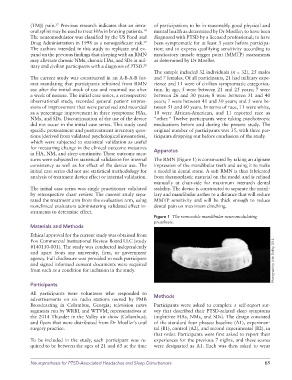
              in HA, NM, and sleep continuity. These outcome mea-  Apparatus
              sures were subjected to statistical validation for internal   The RMN (Figure 1) is constructed by taking an alginate
              consistency as well as for effect of the device use. The   impression of the mandibular teeth and using it to make
              initial case series did not use statistical methodology for   a model in dental stone. A soft RMN is then fabricated
              analysis of treatment device effect or internal validation.  from thermoplastic material on the model and is refined
                                                                 manually at chair-side for maximum interarch dental
              The initial case series was single practitioner validated   stability. The device is constructed to separate the maxil-
              by retrospective chart review. The current study sepa-  lary and mandibular arches to a distance that will reduce
              rated the treatment arm from the evaluation arm, using   MMTP sensitivity and will be thick enough to reduce
              nonclinical evaluators administering validated effect in-  dental pain on maximum clinching.
              struments to determine effect.
                                                                 Figure 1  The removable mandibular neuromodulating
                                                                 prosthesis.
              Materials and Methods
              Ethical approval for the current study was obtained from
              Fox Commercial Institutional Review Board LLC (study
              #140130-001). The study was conducted independently
              and apart from any university, firm, or government
              agency. Full disclosure was provided to each participant                                            Photograph by John Duffey, 2014.
              and signed informed consent documents were required
              from each as a condition for inclusion in the study.


              Participants
              All participants were volunteers who responded to
              advertisements on six radio stations owned by PMB   Methods
              Broadcasting in Columbus, Georgia; television news   Participants were  asked to complete  a self-report sur-
              segments run by WRBL and WTVM; representatives at   vey that described their PTSD-related sleep symptoms
              the 2014 Thunder in the Valley air show (Columbus);   (nighttime HAs, NMs, and SDs). The design consisted
              and flyers that were distributed from Dr Moeller’s oral   of the standard four phases: baseline (A1), experimen-
              surgery practice.                                  tal (B1), control (A2), and second experimental (B2), in
                                                                 that order. Participants were first asked to report their
              To be included in the study, each participant was re-  experiences for the previous 7 nights, and these scores
              quired to be between the ages of 21 and 65 at the time   were designated as A1. Each was then asked to wear


              Neuroprothesis for PTSD-Associated Headaches and Sleep Disturbances                             65

