


Page 77 - Journal of Special Operations Medicine - Fall 2014
P. 77
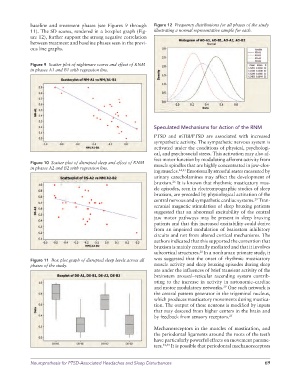
baseline and treatment phases (see Figures 9 through   Figure 12  Frequency distributions for all phases of the study
              11). The SD scores, rendered in a boxplot graph (Fig-  illustrating a normal representative sample for each.
              ure 12), further support the strong negative correlation
              between treatment and baseline phases seen in the previ-
              ous line graphs.


              Figure 9  Scatter plot of nightmare scores and effect of RNM
              in phases A1 and B1 with regression line.


                                                                 Speculated Mechanisms for Action of the RNM
                                                                 PTSD and mTBI/PTSD are associated with increased
                                                                 sympathetic activity. The sympathetic nervous system is
                                                                 activated under the conditions of physical, psychologi-
                                                                 cal, and psychosocial stress. This activation may also af-
                                                                 fect motor function by modulating afferent activity from
              Figure 10  Scatter plot of disrupted sleep and effect of RNM   muscle spindles that are highly concentrated in jaw-clos-
              in phases A2 and B2 with regression line.
                                                                 ing muscles. 24,27  Emotionally stressful states measured by
                                                                 urinary catecholamines may affect the development of
                                                                 bruxism.  It is known that rhythmic masticatory mus-
                                                                        26
                                                                 cle episodes, seen in electromyographic studies of sleep
                                                                 bruxism, are preceded by physiological activation of the
                                                                 central nervous and sympathetic cardiac systems.  Tran-
                                                                                                          29
                                                                 scranial magnetic stimulation of sleep bruxing patients
                                                                 suggested that  an abnormal excitability of  the central
                                                                 jaw motor pathways may be present in sleep bruxing
                                                                 patients and that this increased excitability could derive
                                                                 from an impaired modulation of brainstem inhibitory
                                                                 circuits and not from altered cortical mechanisms. The
                                                                 authors indicated that this supported the contention that
                                                                 bruxism is mainly centrally mediated and that it involves
                                                                 subcortical structures. In a nonhuman primate study, it
                                                                                    28
              Figure 11  Box plot graph of disrupted sleep levels across all   was suggested that the onset of rhythmic masticatory
              phases of the study.                               muscle activity and sleep bruxing episodes during sleep
                                                                 are under the influences of brief transient activity of the
                                                                 brainstem arousal–reticular ascending system contrib-
                                                                 uting  to  the  increase  in  activity  in  autonomic–cardiac
                                                                 and motor modulatory networks.  One such network is
                                                                                             29
                                                                 the central pattern generator in the trigeminal nucleus,
                                                                 which produces masticatory movements during mastica-
                                                                 tion. The output of these neurons is modified by inputs
                                                                 that may descend from higher centers in the brain and
                                                                 by feedback from sensory receptors. 25

                                                                 Mechanoreceptors in the muscles of mastication, and
                                                                 the periodontal ligaments around the roots of the teeth
                                                                 have particularly powerful effects on movement parame-
                                                                 ters. 34,35  It is possible that periodontal  mechanoreceptors


              Neuroprothesis for PTSD-Associated Headaches and Sleep Disturbances                             69

