


Page 74 - Journal of Special Operations Medicine - Fall 2014
P. 74
the RMN while sleeping for 7 consecutive nights. When   Significant differences may be examined according to a
          these 7 nights were completed, participants were asked   nonparametric test, such as the Wilcoxon signed-rank
          to report their experiences for the previous 5 nights of   test used here, and central tendencies may be expressed
          sleep, allowing 2 nights to acclimate to the sensations   as medians.
          of sleeping with the device in their mouth. These scores
          were designated as B1.
                                                             Results
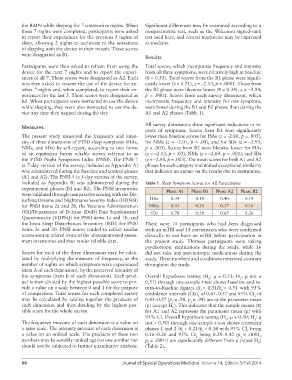
          Participants were then asked to refrain from using the   Total scores, which incorporate frequency and intensity
          device for the next 7 nights and to report the experi-  from all three symptoms, were relatively high at baseline
                                                              –
          ences of all 7. These scores were designated as A2. Each   (x = 0.53). Total scores from the B1 phase were signifi-
                                                                         –
          was then asked to resume the use of the device for an-  cantly lower (x = 0.21), z = –2.53, p = .0001. Those from
                                                                                           –
          other 7 nights and, when completed, to report their ex-  the B2 phase were likewise lower (x = 0.34), z = –2.94,
          periences for the last 5. These scores were designated as   p = .0001. Scores from each survey dimension, which
          B2. When participants were instructed to use the device   incorporate frequency and intensity for one symptom,
          while sleeping, they were also instructed to use the de-  were lower during the B1 and B2 phases than during the
          vice any time they napped during the day.          A1 and A2 phases (Table 1).

                                                             All survey dimensions show significant reductions in re-
          Measures
                                                             ports of symptoms. Scores from B1 were significantly
          The present study measured the frequency and inten-  lower than baseline scores for HAs (z = -2.80, p = .005),
          sity of three dimensions of PTSD sleep symptoms (HAs,   for NMs (z = –2.01, p = .04), and for SDs (z = –2.93,
          NMs, and SDs) by self-report, according to two forms   p = .003). Scores from B2 were likewise lower for HAs
          of  an equivalent  forms  reliable survey  referred  to  as   (z = –2.13, p = .03), NMs (z = –2.60, p = .001), and SDs
          the PTSD Night Symptoms Index (PNSI). The PNSI-7   (z = –2.93, p = .003). The mean scores for both A1 and A2
          (a 7-day version of the survey, included as Appendix A)   phases for each category maintained exceptional similarity
          was administered during the baseline and control phases   that indicates no impact on the results due to maturation.
          (A1 and A2). The PNSI-5 (a 5-day version of the survey,
          included as Appendix B) was administered during the   Table 1  Sleep Symptom Scores for All Participants
          experimental phases (B1 and B2). The PNSI inventories       Phase A1  Phase B1  Phase A2  Phase B2
          were validated through comparative scoring with the Dis-
          turbing Dreams and Nightmares Severity Index (DDNSI)   HAs    0.39      0.19      0.40      0.19
          for PNSI items 2a and 2b, the Veterans Administration   NMs   0.43      0.20      0.37      0.16
          (VA)/Department of Defense (DoD) Pain Supplemental   SDs      0.78      0.28      0.65      0.26
          Questionnaire (VDPSQ) for PNSI items 1a and 1b, and
          the Iowa Sleep Disturbances Inventory (ISDI) for PNSI   There were  14 participants who had been diagnosed
          items 3a and 3b. PNSI scores tended to reflect similar   with an mTBI and 15 participants who were confirmed
          scores seen in related items of the aforementioned assess-  clinically to not have an mTBI before participation in
          ment inventories and thus render reliable data.    the present study. Thirteen participants were taking
                                                             psychotropic medications during the study, while 16
          Scores for each of the three dimensions may be calcu-  did not take any psychotropic medications during the
          lated by multiplying the measure of frequency, as the   study. These numbers and conditions remained constant
          number of nights on which symptoms were experienced   throughout the study.
          (item A of each dimension), by the perceived intensity of
          the symptoms (item B of each dimension). Each prod-  Overall hypothesis testing (H : μ = 0.51; H : μ not =
                                                                                                    1
                                                                                       0
          uct is then divided by the highest possible score to pro-  0.51) through one-sample t-test shows baseline and re-
                                                                                   –
                                                                                           –
          vide a value on a scale between 0 and 1 for the purpose   turn-to-baseline figures (x = 0.51/x = 0.51 with 95%
                                                                                    1
                                                                                            2
          of comparison. Total scores for each completed survey   confidence intervals (CIs)  of 0.45–0.57 and 95% CI  of
                                                                                   1
                                                                                                          2
          may be calculated by adding together the products of   0.45–0.57 (p = .98, p = .94) are at the parameter mean
                                                                                2
                                                                        1
                                                                                                           –
          each dimension and then dividing by the highest pos-  (μ) (accept H ). This indicates that the sample means (x)
                                                                        0
          sible score for the whole survey.                  for A1 and A2 represent the parameter mean (μ) with
                                                             95% CI. Overall hypothesis testing (H : μ = 0.50; H : μ
                                                                                              0
                                                                                                          1
          The frequency measure of each dimension is a value on   not = 0.50) through one-sample t-test shows treatment
                                                                           –
                                                                                   –
          a ratio scale. The intensity measure of each dimension is   phases 1 and 2 (x = 0.21/x = 0.34 with 95% CI  being
                                                                                                       1
                                                                                    2
                                                                            1
          a value on an ordinal scale. The products of these two   0.16–0.26 and 95% CI  being 0.28–0.42 (p = .0001,
                                                                                  2
                                                                                                    1
          numbers may be sensibly ranked against one another but   p = .0001) are significantly different from μ (reject H )
                                                              2
                                                                                                            0
          should not be subjected to further quantitative analysis.   (Table 2).
          66                                       Journal of Special Operations Medicine  Volume 14, Edition 3/Fall 2014

