


Page 69 - Journal of Special Operations Medicine - Fall 2014
P. 69
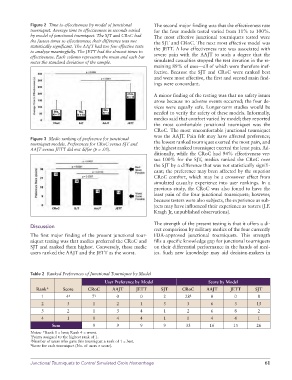
Figure 2  Time to effectiveness by model of junctional   The second major finding was that the effectiveness rate
              tourniquet. Average time to effectiveness in seconds varied   for the four models tested varied from 11% to 100%.
              by model of junctional tourniquet. The SJT and CRoC had   The most effective junctional tourniquets tested were
              the fastest times to effectiveness; their difference was not   the SJT and CRoC. The next most effective model was
              statistically significant. The AAJT had too few effective tests   the JETT. A low effectiveness rate was associated with
              to analyze meaningfully. The JETT had the slowest times to
              effectiveness. Each column represents the mean and each bar   severe pain with the AAJT to such a degree that the
              notes the standard deviation of the sample.        simulated casualties stopped the test iteration in the re-
                                                                 maining 89% of uses—all of which were therefore inef-
                                                                 fective. Because the SJT and CRoC were ranked best
                                                                 and were most effective, the first and second main find-
                                                                 ings were concordant.

                                                                 A minor finding of the testing was that no safety issues
                                                                 arose because no adverse events occurred; the four de-
                                                                 vices were equally safe. Longer-term studies would be
                                                                 needed to verify the safety of these models. Informally,
                                                                 medics said that comfort varied by model; they reported
                                                                 the most comfortable junctional tourniquet was the
                                                                 CRoC. The most uncomfortable junctional tourniquet
                                                                 was the AAJT. Pain felt may have affected preference;
              Figure 3  Medic ranking of preference for junctional
              tourniquet models. Preferences for CRoC versus SJT and   the lowest ranked tourniquet exerted the most pain, and
              AAJT versus JETT did not differ (p > .05).         the highest ranked tourniquet exerted the least pain. Ad-
                                                                 ditionally, while the CRoC had 94% effectiveness ver-
                                                                 sus 100% for the SJT, medics ranked the CRoC over
                                                                 the SJT by a difference that was not statistically signifi-
                                                                 cant; the preference may been affected by the superior
                                                                 CRoC comfort, which may be a crossover effect from
                                                                 simulated casualty experience into user rankings. In a
                                                                 previous study, the CRoC was also found to have the
                                                                 least pain of the four junctional tourniquets; however,
                                                                 because testers were also subjects, the experience as sub-
                                                                 jects may have influenced their experience as testers (J.F.
                                                                 Kragh Jr, unpublished observations).

                                                                 The strength of the present testing is that it offers a di-
              Discussion
                                                                 rect comparison by military medics of the four currently
              The first major finding of the present junctional tour-  FDA-approved  junctional  tourniquets.  This strength
              niquet testing was that medics preferred the CRoC and   fills a specific knowledge gap for junctional tourniquets
              SJT and ranked them highest. Conversely, these medic   on their differential performance in the hands of med-
              users ranked the AAJT and the JETT as the worst.   ics. Such new knowledge may aid decision-makers in


              Table 2  Ranked Preferences of Junctional Tourniquet by Model
                                            User Preference by Model                   Score by Model
                Rank*      Score     CRoC      AAJT      JETT       SJT     CRoC      AAJT      JETT      SJT
                  1         4 †        7 ‡       0         0         2       28 §       0         0        8
                  2          3         1         2         1         5        3         6         3        15
                  3          2         1         3         4         1        2         6         8        2
                  4          1         0         4         4         1        0         4         4        1
                       Sum             9         9         9         9        33        16       15        26
              Notes: *Rank 1 = best; Rank 4 = worst.
              † Points assigned to the highest rank of 1.
              ‡ Number of users who gave this tourniquet a rank of 1 = best.
              § Score for each tourniquet (No. of users × score).


              Junctional Tourniquets to Control Simulated Groin Hemorrhage                                    61

