


Page 67 - Journal of Special Operations Medicine - Fall 2014
P. 67
officers (NCOs) of the rank of staff sergeant (E-6; Mili-  the groin), so the number of tests for a tester was eight
              tary Occupational Specialty 68W, Healthcare Special-  (four models × two sides); a tester applied the four tour-
              ist); 100% had combat experience.                  niquets for a total of eight times to one casualty. This
                                                                 testing resulted in a total of 72 tests (nine testers × four
              Before working with human subjects, these medics were   devices × two sides).
              trained to proficiency by the assessors through the use
              of (1) online videos, (2) user hardcopy instructions, (3)   The focus of the testing was the medics’ experience
              device handling, and (4) three consecutive, successful   in tourniquet use. The surrogate for bleeding was the
              uses of the device on a manikin (CRoC Trainer Manikin,   presence of a distal pulse detected by using hand-held
              Operative Experience, Inc.; http://operativeexperience   Doppler transducer (Nicolet Vascular Elite Model 100;
              .com/). Ten medics were trained to proficiency. One   Viasys Healthcare, Conshohocken, PA), which makes an
              medic withdrew from the testing because of a recurrence   audible pulse sound. Pulse absence represented hemor-
              of mild, temporary, and focal abdominal discomfort as-  rhage control. Effectiveness was defined as stopping the
              sociated with polycystic ovarian disease. The discomfort   distal pulse by Doppler auscultation. The distal pulse
              recurred in the first seconds of use of the first device ap-  check was in the leg (Doppler flow detection) in the pos-
              plied, so testing was not completed for this individual.   terior tibialis artery at the ankle.
              The nine remaining medics participating in the present
              study (seven men and two women) tested the tourni-  Safety was defined as an absence of adverse events (any
              quets on one another; the participants alternated be-  undesirable sign, symptom, or medical or psychological
              tween being testers and simulated casualties.      condition). Uncomplicated pain that resolved promptly
                                                                 after device use was not considered an adverse event
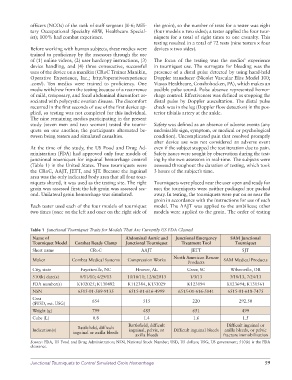
              At the time of the study, the US Food and Drug Ad-  even if the subject stopped the test iteration due to pain.
              ministration (FDA) had approved only four models of   Safety issues were sought by observation during the test-
              junctional tourniquet for inguinal hemorrhage control   ing by the two assessors in real-time. The subjects were
              (Table 1) in the United States. These tourniquets were   assessed throughout the duration of testing, which took
              the CRoC, AAJT, JETT, and SJT. Because the inguinal   3 hours of the subject’s time.
              area was the only indicated body area that all four tour-
              niquets shared, it was used as the testing site. The right   Tourniquets were placed near the user open and ready for
              groin was assessed first; the left groin was assessed sec-  use; the tourniquets were neither packaged nor packed
              ond. Unilateral groin hemorrhage was simulated.    away. In testing, the tourniquets were put on or near the
                                                                 groin in accordance with the instructions for use of each
              Each tester used each of the four models of tourniquet   model. The AAJT was applied to the umbilicus; other
              two times (once on the left and once on the right side of   models were applied to the groin. The order of testing


              Table 1  Junctional Tourniquet Traits for Models That Are Currently US FDA Cleared

              Name of                                Abdominal Aortic and   Junctional Emergency   SAM Junctional
              Tourniquet Model  Combat Ready Clamp   Junctional Tourniquet  Treatment Tool        Tourniquet
              Short name              CRoC                 AAJT                 JETT                 SJT
                                                                         North American Rescue
              Maker            Combat Medical Systems  Compression Works                     SAM Medical Products
                                                                               Products
              City, state         Fayetteville, NC       Hoover, AL           Greer, SC         Wilsonville, OR
              510(k) date(s)      8/11/10; 4/29/13    10/18/11; 12/6/2013       1/3/13          3/18/13, 7/24/13
              FDA number(s)      K102025; K130482     K112384, K133029        K123194          K123694; K131561
              NSN                6515-01-589-9135     6515-01-616-4999     6515-01-616-5841    6515-01-618-7475
              Cost                     654                  515                  220                292.50
              ($USD, est. USG)
              Weight (g)               799                  485                  651                 499
              Cube (L)                 0.8                  1.4                  1.6                 1.5
                                                      Battlefield, difficult                   Difficult inguinal or
                                 Battlefield, difficult
              Indication(s)                           inguinal, pelvis, or    Difficult inguinal bleeds  axilla bleeds, or pelvic
                               inguinal or axilla bleeds
                                                         axilla bleeds                       fracture immobilization
              Source: FDA, US Food and Drug Administration; NSN, National Stock Number; USD, US dollars; USG, US government; 510(k) is the FDA
              clearance.


              Junctional Tourniquets to Control Simulated Groin Hemorrhage                                    59

