


Page 57 - Journal of Special Operations Medicine - Spring 2014
P. 57
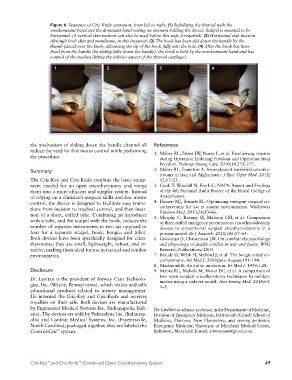
Figure 6  Sequence of Cric-Knife operation, from left to right: (1) Stabilizing the thyroid with the
                      nondominant hand and the dominant hand resting on sternum holding the device. Scalpel is oriented to be
                      horizontal. [A vertical skin incision can also be used before this step, if required]. (2) Horizontal stab incision
                      (through both skin and membrane, in this instance). (3) The hook has been slid down the handle by the
                      thumb placed over the knob, advancing the tip of the hook fully into the hole. (4) After the hook has been
                      freed from the handle (by sliding fully down the handle), the hook is held by the nondominant hand and has
                      control of the trachea (lifting the inferior aspect of the thyroid cartilage).

                       1                     2                     3                     4


              the mechanism of sliding down the handle channel all   References
              reduce the need for fine motor control while performing   1.  Mabry RL, Edens JW, Pearse L, et al. Fatal airway injuries
              the procedure.                                       during Operation Enduring Freedom and Operation Iraqi
                                                                   Freedom. Prehosp Emerg Care. 2010;14:272–277.
                                                                 2.  Mabry RL, Frankfurt A. An analysis of battlefield cricothy-
              Summary
                                                                   rotomy in Iraq and Afghanistan. J Spec Oper Med. 2012;
              The Cric-Key and Cric-Knife combine the basic equip-  12:17–23.
              ment needed for an open cricothyrotomy and merge   3.  Cook T, Woodall N, Frerk C. NAP4: Report and Findings
              them into a more efficient and simpler system. Instead   of the 4th National Audit Project of the Royal College of
              of relying on a clinician’s surgical skills and fine motor   Anaesthetists.
              control, the device is designed to facilitate easy transi-  4.  Hessert MJ, Bennett BL. Optimizing emergent surgical cri-
              tions from incision to tracheal control, and then inser-  cothyrotomy for use in austere environments. Wilderness
                                                                   Environ Med. 2013;24:53–66.
              tion of a short, cuffed tube. Combining an introducer   5.  Murphy C, Rooney SJ, Maharaj CH, et al. Comparison
              with a tube, and the scalpel with the hook, reduces the   of three cuffed emergency percutaneous cricothyroidotomy
              number of separate instruments to two (as opposed to   devices to conventional surgical cricothyroidotomy in a
              four  for  a  separate  scalpel,  hook,  bougie,  and  tube).   porcine model. Br J Anaesth. 2011;106:57–64.
              Both devices have been specifically designed for crico-  6.  Grossman D, Christensen LW. On combat: the psychology
              thyrotomy; they are small, lightweight, robust, and in-  and physiology of deadly conflict in war and peace. WSG
              tuitive, making them ideal for use in tactical and combat   Research Publications; 2004.
              environments.                                      7.  Braude D, Webb H, Stafford J, et al. The bougie aided cri-
                                                                   cothyrotomy. Air Med J. 2009;July–August:191–194.
                                                                 8.  Macintosh R. An aid to intubation. Br Med J. 1949;1:28.
              Disclosure                                         9.  Mabry RL, Nichols M, Shiner DC, et al. A comparison of
                                                                   two open surgical cricothyrotomy techniques by military
              Dr. Levitan is the president of Airway Cam Technolo-  medics using a cadaver model. Ann Emerg Med. 2014;63:
              gies, Inc. (Wayne, Pennsylvania), which makes and sells   1–5.
              educational products related to airway management.
              He invented the Cric-Key and Cric-Knife and receives
              royalties on their sale. Both devices are manufactured
              by Engineered Medical Systems Inc. (Indianapolis, Indi-  Dr. Levitan is adjunct professor in the Department of Medicine,
              ana). The devices are sold by Pulmodyne Inc. (Indianap-  Division of Emergency Medicine, Dartmouth (Geisel) School of
              olis) and Combat Medical Systems, Inc. (Fayettesville,   Medicine, Hanover, New Hampshire, and visiting professor,
              North Carolina); packaged together, they are labeled the   Emergency Medicine, University of Maryland Medical Center,
                Control-Cric™ system.                            Baltimore, Maryland. E-mail: airwaycam@gmail.com.


              Cric-Key  and Cric-Knife : Combined Open Cricothyrotomy System                                  49
                    ™
                                 ™

