


Page 62 - Journal of Special Operations Medicine - Spring 2014
P. 62
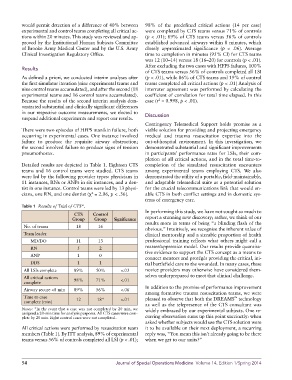
would permit detection of a difference of 40% between   98% of the predefined critical actions (14 per case)
          experimental and control teams completing all critical ac-  were completed by CTS teams versus 71% of controls
          tions within 20 minutes. This study was reviewed and ap-  (p < .01); 89% of CTS teams versus 56% of controls
          proved by the Institutional Human Subjects Committee   established advanced airways within 8 minutes, which
          of Brooke Army Medical Center and by the U.S. Army   closely approximated significance (p < .06). Average
          Clinical Investigation Regulatory Office.          time to completion in minutes (95% CI) for CTS teams
                                                             was 12 (10–14) versus 18 (16–20) for controls (p < .01).
                                                             After excluding the two cases with HFPS failures, 100%
          Results
                                                             of CTS teams versus 56% of controls completed all LSI
          As defined a priori, we conducted interim analyses after   (p < .01), while 86% of CTS teams and 19% of control
          the first simulator iteration (nine experimental teams and   teams completed all critical actions (p < .01) Analysis of
          nine control teams accumulated), and after the second (18   interrater agreement was performed by calculating the
          experimental teams and 16 control teams accumulated).   coefficient of correlation for total time elapsed. In this
          Because the results of the second interim analysis dem-  case (r  = 0.998, p < .01).
                                                                   2
          onstrated substantial and clinically significant differences
          in our respective outcome measurements, we elected to
          suspend additional experiments and report our results.  Discussion
                                                             Contingency Telemedical Support holds promise as a
          There were two episodes of HFPS manikin failure, both   viable solution for providing and projecting emergency
          occurring in experimental cases. One instance involved   medical and trauma resuscitation expertise into the
          failure  to  produce  the requisite  airway  obstruction;   out-of-hospital environment. In this investigation, we
          the second involved failure to produce signs of tension   demonstrated substantial and significant improvements
          pneumothorax.                                      in participants’ performance rates for LSIs, their com-
                                                             pletion of all critical actions, and in the total time-to-
          Detailed results are depicted in Table 1. Eighteen CTS   completion of the simulated resuscitation encounters
          teams and 16 control teams were studied. CTS teams   among  experimental  teams  employing  CTS.  We  also
          were led by the following provider types: physicians in   demonstrated the utility of a portable, field-maintainable,
          11 instances, RNs or ANPs in six instances, and a den-  and adaptable telemedical suite as a potential solution
          tist in one instance. Control teams were led by 13 physi-  for the crucial telecommunications link that would en-
          cians, one RN, and one dentist (χ  = 2.06, p < .36).  able CTS in both conflict settings and in domestic sys-
                                       2
                                                             tems of emergency care.
          Table 1  Results of Trial of CTS*.
                                                             In performing this study, we have not sought so much to
                                CTS    Control
                               Group    Group   Significance  report a stunning new discovery; rather, we think of our
                                                             results more in terms of being “a blinding flash of the
           No. of teams         18        16
                                                             obvious.” Intuitively, we recognize the inherent value of
           Team leader                                       clinical mentorship and a sizeable proportion of health
              MD/DO             11        13                 professional  training  reflects  what  others  might  call  a
              RN                 5        2                  master/apprentice model. Our results provide quantita-
                                                             tive evidence to support the CTS concept as a means to
              ANP                1        0
                                                             connect mentors and protégés providing the critical, ini-
              DDS                1        1                  tial battlefield care to the wounded. In many cases, these
           All LSIs complete    89%      50%       <.03      novice providers may otherwise have considered them-
           All critical actions   98%    71%       <.01      selves underprepared to meet that clinical challenge.
           complete
                                                             In addition to the promise of performance improvement
           Airway secure <8 min  89%     56%       <.06
                                                             among formative trauma resuscitation teams, we were
           Time to case         12       18*       <.01      pleased to observe that both the DREAMS  technology
                                                                                                  ™
           complete (min)
                                                             as well as the telepresence of the CTS consultant was
          Notes: *In the event that a case was not completed by 20 min, we   widely embraced by our experimental subjects. One re-
          assigned a 20-min time for analysis purposes. All CTS cases were com-
          plete by 20 min. Eight control cases were not completed.  curring observation sums up this point succinctly: when
                                                             asked whether subjects would use the CTS solution were
          All critical actions were performed by resuscitation team   it to be available on their next deployment, a recurring
          members (Table 1). By ITT analysis, 89% of experimental   reply was, “You mean this isn’t already going to be there
          teams versus 56% of controls completed all LSI (p < .01);    when we get to our units?”


          54                                     Journal of Special Operations Medicine  Volume 14, Edition 1/Spring 2014

