


Page 67 - Journal of Special Operations Medicine - Spring 2014
P. 67
tested had deficient or insufficient levels of serum vita-  vitamin D undergoes a series of biochemical changes to
              min D (Table 1). This contrasts with a study that mea-  convert to its active form. Endogenous synthesis occurs in
              sured serum vitamin D levels in 1993 during a Special   response to UVB photons from sunlight to form vitamin
              Forces Assessment and Selection (SFAS) Course that   D from cholesterol. Dietary sources include vitamin D
                                                                  3
                                                                                                                3
              found vitamin D levels within the normal range, sug-  as well as the plant form of vitamin D . Neither vitamin
                                                                                                 2
              gesting that SOF vitamin D levels have decreased over   D form has biological activity until a series of enzymes
              the past two decades.  Since SFAS occurs in the same re-  alter its structure. First, vitamin D is hydroxylated in
                                2
              gion as WAMC, geography or climatology does not ex-  the liver to produce 25-hydroxyvitamin D [25(OH)D].
              plain the differences in vitamin D status. These vitamin   Then, 25(OH)D is further hydroxylated in the kidney
              D levels persist despite the use of dietary supplements.   to produce 1,25-dihydroxyvitamin D [1,25(OH) D],
                                                                                                             2
              According to published survey results, 46% of Special   which is the active form. In addition to the liver and kid-
              Forces Operators consume multivitamins (although the   ney, vitamin D hydroxylating enzymes have been identi-
              vitamin D content in most multivitamins is inadequate   fied in other tissues. Vitamin D increases or decreases
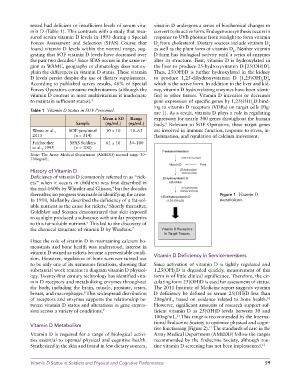
              to maintain sufficient status). 3                  gene expression of specific genes by 1,25(OH) D bind-
                                                                                                         2
                                                                 ing to vitamin D receptors (VDRs) on target cells (Fig-
              Table 1  Vitamin D Status in SOF Personnel.
                                                                 ure 1). As a result, vitamin D plays a role in regulating
                                           Mean ± SD   Range     expression for nearly 300 genes throughout the human
                                Sample       (ng/mL)  (ng/mL)    body.  Relevant to SOF Operators, these target genes
                                                                     9
              Wentz et al.,    SOF personnel   30 ± 10  10–63    are involved in immune function, response to stress, in-
              2013              (n = 314)                        flammation, and regulation of calcium movement.
              Fairbrother     SFAS Soldiers   61 ± 16  34–100
              et al., 1995      (n = 100)
              Note: The Army Medical Department (AMEDD) normal range 30–
              100ng/mL.


              History of Vitamin D
              Deficiency of vitamin D (commonly referred to as “rick-
              ets” when it occurs in children) was first described in
              the mid-1600s by Whistler and Glisson,  but for decades
                                               4
              thereafter, no progress was made in identifying the cause.                    Figure 1  Vitamin D
              In 1918, Mellanby described the deficiency of a fat-sol-                      metabolism.
              uble nutrient as the cause for rickets. Shortly thereafter,
                                             5
              Goldblatt and Soames demonstrated that skin exposed
              to sunlight produced a substance with similar properties
              to this fat-soluble nutrient.  This led to the discovery of
                                     6
              the chemical structure of vitamin D by Windaus. 7
              Once the role of vitamin D in maintaining calcium ho-
              meostasis and bone health was understood, interest in
              vitamin D waned as rickets became a preventable condi-
              tion. However, regulation of bone turnover turned out   Vitamin D Deficiency in Servicemembers
              to be only one of its numerous functions, showing that   Since activation of vitamin D is tightly regulated and
              substantial work remains to diagram vitamin D physiol-  1,25(OH) D is degraded quickly, measurement of this
                                                                         2
              ogy. Twenty-first century technology has identified vita-  form is of little clinical significance. Therefore, the cir-
              min D receptors and metabolizing enzymes throughout   culating form 25(OH)D is used for assessment of status.
              the body, including the brain, muscle, prostate, testes,   The 2011 Institute of Medicine report suggests vitamin
              breast, and macrophages. This widespread distribution   D deficiency be defined as serum 25(OH)D less than
                                    8
              of receptors and enzymes supports the relationship be-  20ng/mL, based on evidence related to bone health.
                                                                                                               10
              tween vitamin D status and alterations in gene expres-  However, significant amounts of research support suf-
              sion across a variety of conditions. 9             ficient vitamin D as 25(OH)D levels between 30 and
                                                                 100ng/mL.  This range is recommended by the Interna-
                                                                          11
                                                                 tional Endocrine Society to optimize physical and cogni-
              Vitamin D Metabolism
                                                                 tive functioning (Figure 2).  The standards of care in the
                                                                                       11
              Vitamin D is required for a range of biological activi-  Army Medical Department (AMEDD) follow the ranges
              ties essential to optimal physical and cognitive health.   recommended by the Endocrine Society, although rou-
              Synthesized in the skin and found in few dietary sources,   tine vitamin D screening has not been implemented. 12


              Vitamin D Status in Soldiers and Physical and Cognitive Performance                             59

