


Page 54 - Journal of Special Operations Medicine - Spring 2014
P. 54
are large and difficult to insert into the 8 to 11mm space   anterior tracheal rings, the bougie usually distinguishes
          between the cricoid and thyroid cartilages. Standard   between tracheal and esophagus placement based on
          tracheal tubes are intended for oral and nasal intuba-  depth of insertion. When inserted into the trachea, the
          tion and are much too long for insertion below the vocal   device stops as the leading edge gets wedged into smaller
          cords. The distance from the vocal cords to the carina   and smaller bronchi; conversely, this holdup should not
          averages only 11cm, while standard tubes are approxi-  occur if passing into the esophagus and stomach.
          mately 30cm long (i.e., they can easily wind up in the
          mainstem bronchi, ventilating only one lung). Standard   Palpation of the tracheal rings is not guaranteed when
          tubes are also not easily secured to the neck (at the right   using  the  bougie  through  a  cricothyrotomy  incision,
          depth) after insertion. Mainstem intubation is common   however. The angle of insertion is very steep and the
          after emergent surgical airways performed with stan-  tip may not make contact with the rings. Confirma-
          dard tracheal tubes. 4                             tion in the trachea can usually be confirmed based on
                                                             depth of insertion (it stops on reaching smaller bronchi).
          A common error when performing cricothyrotomy is   Disadvantages of using the bougie when performing a
          losing the hole after entering the trachea, and subsequent   cricothyrotomy include its long length, adding a step be-
          placement of the tube into the subcutaneous space. 2,4,7    tween the incision and tube placement, and the potential
          Some authors have advocated use of a finger in the hole   to create a false passage on insertion.
          or placing the handle of a scalpel in the hole to prevent
          loss of the trachea.  An inadequately sized incision and       ™
                          4
          blood pooling in the hole make correct insertion into the   The Cric-Key
          trachea challenging. Inserting a finger or scalpel handle   The Cric-Key was invented to verify tracheal location
          into the hole after the incision is not a guaranteed solu-  during surgical airway procedures—without the need
          tion, because such techniques still involve a transition   for visualization, aspiration of air, or reliance on clini-
          where there is nothing in the hole. Placement of a fin-  cians’ fine motor skills. It incorporates a short curvilin-
          ger, the scalpel handle, or a bougie into the hole is not   ear introducer and an overlying cricothyrotomy tube.
          instantaneous, and it is easy to create a false passage   The verification of placement in the trachea is by palpa-
          under the skin but above the trachea.              tion of the tracheal rings, similar to a bougie during oral
                                                             intubation, but it has a special shape, overall length, and
          The bougie-aided cricothyrotomy, as described by   rigidity specifically for cricothyrotomy.
          Braude and others, involves initial placement of a bou-
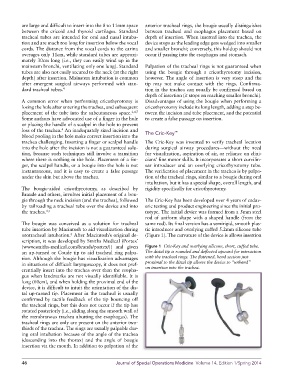
          gie through the neck incision (and the trachea), followed   The Cric-Key has been developed over 4 years of cadav-
          by railroading a tracheal tube over the device and into   eric testing and product engineering since the initial pro-
          the trachea. 4,7                                   totype. The initial device was formed from a 5mm steel
                                                             rod of uniform shape with a shaped handle (from the
          The bougie was conceived as a solution for tracheal   same rod). Its final version has a semirigid, smooth plas-
          tube insertion by Macintosh to aid visualization during   tic introducer and overlying cuffed 5.2mm silicone tube
          orotracheal intubation.  After Macintosh’s original de-  (Figure 1). The curvature of the device is allows insertion
                              8
          scription, it was developed by Smiths Medical (Portex
                                                          ®
          [www.smiths-medical.com/brands/portex/])  and  given   Figure 1  Cric-Key and overlying silicone, short, cuffed tube.
          an up-turned or Coude tip to aid tracheal ring palpa-  The distal tip is rounded and deflected upward for interaction
          tion. Although the bougie has visualization advantages   with the tracheal rings. The flattened, bend section just
          in situations of difficult laryngoscopy, it does not pref-  proximal to the distal tip allows the device to “unbend”
          erentially insert into the trachea over than the esopha-  on insertion into the trachea.
          gus when landmarks are not visually identifiable. It is
          long (60cm), and when holding the proximal end of the
          device, it is difficult to intuit the orientation of the dis-
          tal up-turned tip. Placement in the tracheal is usually
          confirmed  by  tactile  feedback  of the  tip  bouncing  off
          the tracheal rings, but this does not occur if the tip has
          rotated posteriorly (i.e., sliding along the smooth wall of
          the membranous trachea abutting the esophagus). The
          tracheal rings are only are present on the anterior two-
          thirds of the trachea. The rings are usually palpable dur-
          ing oral intubation because of the angle of the trachea
          (descending into the thorax) and the angle of bougie
          insertion via the mouth. In addition to palpation of the


          46                                     Journal of Special Operations Medicine  Volume 14, Edition 1/Spring 2014

