


Page 56 - Journal of Special Operations Medicine - Spring 2014
P. 56
indentations on the sides for holding the device like a   lateral to the blade tip are also designed to prevent ex-
          pencil, with the second and third fingers on the indenta-  cessive insertion.
          tions. The clinician’s thumb is stabilized on a rounded
          knob projecting up from the middle of the hook. The   After the downward incision is made with the blade, the
          hook is entirely made of brushed aluminum.         thumb slides the hook down the handle into the hole
                                                             (by moving the knob and hook down the scalpel) (Fig-
          The scalpel can be used in either a vertical or a horizon-  ure 6). It should be advanced fully into hole. This is felt
          tal orientation; in most emergent situations, it is advised   mechanically as the leading edge of the hook passes over
          to make a vertical skin incision, confirm the location of   the scalpel and under the inferior edge of the thyroid
          the cricothyroid membrane by palpation, and then ori-  cartilage. The hook has a tip with a triangular shape;
          ent the scalpel to a horizontal orientation for incising   as it is advanced into the hole, there is a distinct click
          the membrane. When the location of the cricothyroid   once the hook passes under the thyroid cartilage. The
          membrane is obvious, the blade can be inserted through   hook slides over the scalpel and is kept flush along the
          skin and membrane together (horizontally). Whether   scalpel by the lateral projections of the hook, which
          an initial vertical or horizontal incision is made on the   move within a channel on the handle. Once the hook
          skin, the cricothyroid membrane is always entered hori-  has been advanced down the handle (so that it has ad-
          zontally with a downward motion (perpendicular to the   vanced fully into the hole made by the scalpel), the hook
          membrane) aiming at the back wall of the cricoid car-  can be lifted away from the scalpel and handle. The
          tilage (Figure 5). It is important to note that the cricoid   transition is quick and easy between the dominant hand
          cartilage has much larger back wall than its relatively   sliding the hook down (the right thumb in the photo-
          small anterior ring. Unlike an incision at the level of the   graphs) and the nondominant hand (the left hand in the
          tracheal rings, where the back of the tracheal is soft,   photographs) grabbing the hook once it has been fully
          flat, and abuts the esophagus, the large back wall of the   advanced. The hook has a large proximal finger hold
          cricoid provides a firm protective stop. Also, because of   that does not require fine motor control. The clinician
          the tight fit of the cricoid cartilage within the overlying   now has control of the trachea with the hook, and a
          thyroid, there is also a cartilaginous stop at the lateral   sufficiently large incision made by the scalpel, to allow
          ends of the cricothyroid membrane. This prevents ex-  insertion of the Cric-Key and overlying tube.
          tension of an incision at the cricothyroid membrane too
          far laterally, limiting the risk of injuring the carotid and   The slide of the hook over the scalpel immediately into
          jugular vessels. The Cric-Knife blade is short in length   the hole reduces the risk of losing the hole; the tip of the
          to prevent overinsertion (so as not to hit the posterior   hook enters fully with a palpable click as it wedges un-
          cricoid wall or the vocal cords), and plastic projections   der the thyroid. The shape of the handle, the hook, and


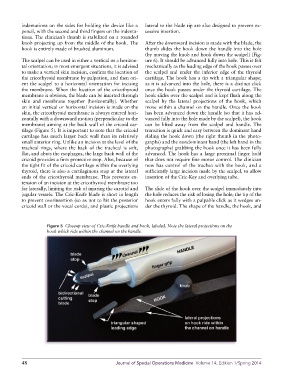
                    Figure 5  Closeup view of Cric-Knife handle and hook, labeled. Note the lateral projections on the
                    hook which ride within the channel on the handle.


          48                                     Journal of Special Operations Medicine  Volume 14, Edition 1/Spring 2014

