


Page 55 - Journal of Special Operations Medicine - Spring 2014
P. 55
into the cricothyrotomy incision and palpation of the   on cadavers versus a traditional open technique. The
              tracheal rings by movement up and down within the   traditional technique was successful only 66% of the
              trachea. The Cric-Key’s subsequent “unbending” of the   time and took on average 65 seconds; the Cric-Key had
              introducer on full insertion is achieved by a modification   a 100% success rate and only took an average of 34
              of the introducer’s cross-sectional shape. Specifically, a   seconds for tube insertion.
              flattened section just proximal to the distal tip allows the
              distal tip to “unbend” or straighten out as it is fully in-     ™
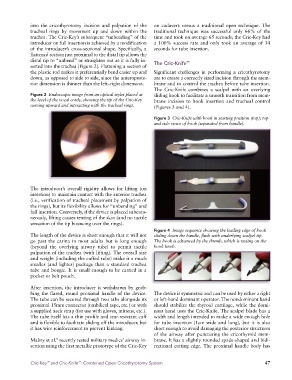
              serted into the trachea (Figure 2). Flattening a section of   The Cric-Knife
              the plastic rod makes it preferentially bend easier up and   Significant challenges in performing a cricothyrotomy
              down, as opposed to side to side, since the anteroposte-  are to create a correctly sized incision through the mem-
              rior dimension is thinner than the left–right dimension.  brane and to control the trachea before tube insertion.
                                                                 The Cric-Knife combines a scalpel with an overlying
              Figure 2  Endoscopic image from an optical stylet placed at   sliding hook to facilitate a smooth transition from mem-
              the level of the vocal cords, showing the tip of the Cric-Key   brane incision to hook insertion and tracheal control
              curving upward and interacting with the tracheal rings.  (Figures 3 and 4).


                                                                 Figure 3  Cric-Knife with hook in starting position (top); top
                                                                 and side views of hook (separated from handle).


              The  introducer’s  overall  rigidity  allows  for  lifting  (on
              insertion) to maintain contact with the anterior trachea
              (i.e., verification of tracheal placement by palpation of
              the rings), but its flexibility allows for “unbending” and
              full insertion. Conversely, if the device is placed subcuta-
              neously, lifting causes tenting of the skin (and no tactile
              sensation of the tip bouncing over the rings).
                                                                 Figure 4  Image sequence showing the leading edge of hook
              The length of the device is short enough that it will not   sliding down the handle, flush with underlying scalpel tip.
              go past the carina in most adults but is long enough   The hook is advanced by the thumb, which is resting on the
              (beyond the overlying airway tube) to permit tactile   hook knob.
              palpation of the trachea (with lifting). The overall size
              and weight (including the cuffed tube) make it a much
              smaller (and lighter) package than a standard trachea
              tube and bougie. It is small enough to be carried in a
              pocket or belt pouch.

              After insertion, the introducer is withdrawn by grab-
              bing the flared, round proximal handle of the device.   The device is symmetric and can be used by either a right
              The tube can be secured through two tabs alongside its   or left-hand dominant operator. The nondominant hand
              proximal 15mm connector (umbilical tape, etc.) or with   should stabilize the thyroid cartilage, while the domi-
              a supplied neck strap (for use with gloves, mittens, etc.).   nant hand uses the Cric-Knife. The scalpel blade has a
              The tube itself has a thin profile and tear-resistant cuff   width and length intended to make a wide enough hole
              and is flexible to facilitate sliding off the introducer, but   for tube insertion (1cm wide and long), but it is also
              it has wire reinforcement to prevent kinking.      short enough to avoid damaging the posterior structures
                                                                 of the airway after puncturing the cricothyroid mem-
              Mabry et al.  recently tested military medics’ airway in-  brane. It has a slightly rounded spade-shaped and bidi-
                        9
              sertion using the first metallic prototype of the Cric-Key    rectional cutting edge. The proximal handle body has


              Cric-Key  and Cric-Knife : Combined Open Cricothyrotomy System                                  47
                                 ™
                    ™

