


Page 49 - Journal of Special Operations Medicine - Spring 2014
P. 49
with the Combat Ready Clamp (CroC ; www.combat     flow, that the system could record effective interven-
                                                ™
              medicalsystems.com).                               tions, and that the model was robust and reproducible.
                                                                 Study
              Methods                                            After confirming that the model would demonstrate
                                                                 pulsatile flow through human anatomy at fluid pres-
              Model Development                                  sures simulating human systolic blood pressure, we per-
              Perfused fresh human cadavers were used to create a   formed a comparative analysis between the JETT and
              hemorrhage model with physiological arterial pressures.   the CRoC. The JETT is a rugged, lightweight, tactical
              The cadavers were not embalmed but instead refriger-  windlass device designed to treat combined pelvic and
              ated at 45°F and placed at ambient room temperature   lower extremity injuries sustained in high-energy trau-
              24 hours before use. The cadavers were all less than 48   matic events on the battlefield and in the civilian envi-
              hours from the time of death. The simulated arterial   ronment. The JETT consists of a belt assembly, with two
              flow was created using a pulsatile pump connected to a   trapezoidal pressure pads and threaded T-handles. It is a
              series of plastic tubing and pressure sensors in combina-  low-volume, lightweight device that is intuitive and easy
              tion with the cadaver arterial vascular system, creating   to apply. It incorporates both a pelvic binder applica-
              a proximal uncontrolled hemorrhage model with an ini-  tion and bilateral hemorrhage control devices designed
              tial systolic pressure between 110 and 120mmHg. Dur-  to occlude either unilateral or bilateral common femoral
              ing model development (two cadavers), the JETT was   artery blood flow to the lower extremities. The device
              compared with the standard-issue combat tourniquet,   can be rapidly employed in lieu of manual pressure, al-
              the Combat Application Tourniquet (C-A-T ; http://  lowing the healthcare provider to perform other inter-
                                                      ®
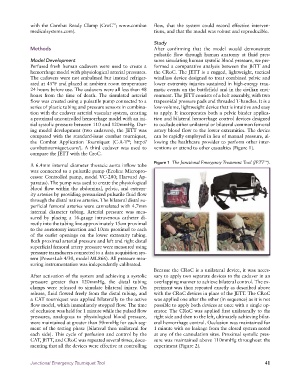
              combattourniquet.com/). A third cadaver was used to   ventions or attend to other casualties (Figure 1).
              compare the JETT with the CroC.
                                                                 Figure 1  The Junctional Emergency Treatment Tool (JETT ).
                                                                                                              ™
              A 6.4mm internal diameter thoracic aorta inflow tube
              was connected to a pulsatile pump (Ecoline Micropro-
              cessor Controlled pump, model VC-280; Harvard Ap-
              paratus). The pump was used to create the physiological
              blood flow within the abdominal, pelvic, and extrem-
              ity arteries by providing pressurized pulsatile fluid flow
              through the distal native arteries. The bilateral distal su-
              perficial femoral arteries were cannulated with 4.7mm
              internal diameter tubing. Arterial pressure was mea-
              sured by placing a 16-gauge intravenous catheter di-
              rectly into the tubing line approximately 15cm proximal
              to the aortotomy insertion and 10cm proximal to each
              of the outlet openings on the lower extremity tubing.
              Both proximal arterial pressure and left and right distal
              superficial femoral artery pressure were measured using
              pressure transducers connected to a data acquisition sys-
              tem (PowerLab 4/30, model ML866). All pressure mea-
              suring instrumentation was independently calibrated.
                                                                 Because the CRoC is a unilateral device, it was neces-
              After activation of the system and achieving a systolic   sary to apply two separate devices to the cadaver in an
              pressure greater than 120mmHg, the distal tubing   overlapping manner to achieve bilateral control. The ex-
              clamps  were released  to simulate bilateral  injury. On   periment was then repeated exactly as described above
              release, fluid flowed freely from the distal tubing, and   with the CRoC devices in place of the JETT. The CRoC
              a CAT tourniquet was applied bilaterally to the active   was applied one after the other (in sequence) as it is not
              flow model, which immediately stopped flow. The time   possible to apply both devices at once with a single op-
              of occlusion was held for 1 minute while the pulsed flow   erator. The CRoC was applied first unilaterally to the
              pressures, analogous to physiological blood pressure,   right side and then to the left, ultimately achieving bilat-
              were maintained at greater than 90mmHg for each seg-  eral hemorrhage control. Occlusion was maintained for
              ment of the testing phase (bilateral then unilateral for   1 minute with no leakage from the closed system noted
              each side). This cycle of perfusion and control by the   at any of the cannulation sites. Proximal systolic pres-
              CAT, JETT, and CRoC was repeated several times, docu-  sure was maintained above 110mmHg throughout the
              menting that all the devices were effective at controlling   experiment (Figure 2).


              Junctional Emergency Tourniquet Tool                                                            41

