


Page 45 - Journal of Special Operations Medicine - Spring 2014
P. 45
difference was less than 1 percentage point, indicating   even when the “true” survival probability curves are some-
              that the ReSTART policy is relatively robust to different   what different from what ReSTART and Simple-ReSTART
              severity distributions. However, improvement in critical   calculations assumed to be. The reader can find more de-
              mortality clearly depended on the resource availability.   tails on this study in the previously published paper. 8
              As the number of ambulances increased, the improve-
              ment from using ReSTART declined from a peak of
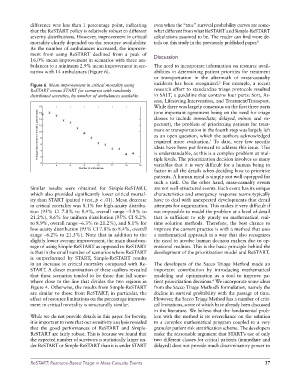
              16.0% mean improvement in scenarios with three am-  Discussion
              bulances to a minimum 2.9% mean improvement in sce-  The need to incorporate information on resource avail-
              narios with 14 ambulances (Figure 6).              abilities in determining patient priorities for treatment
                                                                 or transportation in the aftermath of mass-casualty
                                                                                            2
              Figure 6  Mean improvement in critical mortality using   incidents has been recognized.  For example, a recent
              ReSTART versus START for scenarios with randomly   research effort to standardize triage protocols resulted
              distributed severities, by number of ambulances available.  in SALT, a guideline that contains four parts: Sort, As-
                                                                 sess, Lifesaving Intervention, and Treatment/Transport.
                 18                                              While there was largely consensus on the first three parts
                 Average improvement in mortality (percentage)  12 8 6  pectant), the problem of prioritizing patients for treat-
                                                                 (one important agreement being on the need for triage
                 16
                                                                 classes to include  immediate, delayed, minor,  and  ex-
                 14
                                                                 ment or transportation in the fourth step was largely left
                 10
                                                                 as an open question, which the authors acknowledged
                                                                                        1
                                                                 required more evaluation.  To date, very few specific
                                                                 ideas have been put forward to address this issue. This
                                                                 tiple levels. The prioritization decision involves so many
                  0 4 2                                          is understandable, as this is a complex problem at mul-
                  2     4     6     8    10    12    14   16     variables that it is very difficult for a human being to
                                  Number of ambulances
                                                                 factor in all the details when deciding how to prioritize
                                                                 patients. A human mind is simply not well equipped for
                                                                 such  a  task. On  the  other  hand,  mass-casualty  events
              Similar results were obtained for Simple-ReSTART,   are not well-structured events. Each event has its unique
              which also provided significantly lower critical mortal-  characteristics and emergency response teams typically
              ity than START (paired t test, p < .01). Mean decrease   have to deal with unexpected developments that derail
              in critical mortality was 8.1% for high-acuity distribu-  attempts for organization. This makes it very difficult if
              tion (95% CI 7.8% to 8.4%, overall range –5.8% to   not impossible to model the problem at a level of detail
              21.2%), 8.6% for uniform distribution (95% CI 8.2%   that is sufficient to rely purely on mathematical real-
              to 8.9%, overall range –6.3% to 21.2%), and 8.1% for   time solution methods. Therefore,  the best chance  to
              low-acuity distribution (95% CI 7.8% to 8.4%, overall   improve the current practice is with a method that uses
              range –6.2% to 21.3%). Note that in addition to the   a mathematical approach in a way that also recognizes
              slightly lower average improvement, the main disadvan-  the need to involve human decision makers due to op-
              tage of using Simple-ReSTART as opposed to ReSTART   erational realities. This is the basic principle behind the
              is that in the small number of scenarios where ReSTART   development of the prioritization model and ReSTART.
              is outperformed by START, Simple-ReSTART results
              in an increase in critical mortality compared with Re-  The developers of the Sacco Triage Method made an
              START. A closer examination of these outliers revealed   important contribution by introducing mathematical
              that these scenarios tended to be those that fall some-  model ing and optimization as a tool to improve pa-
              where close to the line that divides the two regions in   tient prioritization decisions.  We incorporate some ideas
                                                                                         4
              Figure 4. Otherwise, the results from Simple-ReSTART   from the Sacco Triage Method’s formulation, namely the
              are similar to those from ReSTART; in particular, the   decline in survival probability with the passage of time.
              effect of resource limitations on the percentage improve-  However, the Sacco Triage Method has a number of criti-
              ment in critical mortality is structurally similar.   cal limitations, some of which have already been discussed
                                                                 in the literature. We believe that the fundamental prob-
              While we do not provide details in this paper for brevity,   lem with the method is its overreliance on the solution
              it is important to note that our sensitivity analysis revealed   to a complex mathematical program coupled to a very
              that the good performances of ReSTART and Simple-   granular patient risk stratification scheme. The developers
              ReSTART are fairly robust. This is because we found that   make the reasonable argument that START’s use of only
              the expected number of survivors is statistically larger un-  two different classes for critical patients (immediate and
              der ReSTART or Simple-ReSTART than it is under START   delayed) does not provide much discriminatory power to


              ReSTART: Resource-Based Triage in Mass-Casualty Events                                          37

