


Page 44 - Journal of Special Operations Medicine - Spring 2014
P. 44
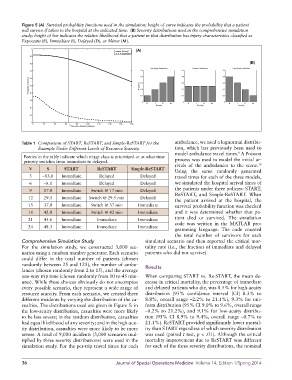
Figure 5 (A)  Survival probability functions used in the simulation; height of curve indicates the probability that a patient
          will survive if taken to the hospital at the indicated time.  (B) Severity distributions used in the comprehensive simulation
          study; height of bar indicates the relative likelihood that a patient in that distribution has injury characteristics classified as
          Expectant (E), Immediate (I), Delayed (D), or Minor (M).
              1
                                                   Delayed  (A)
                                                   Immediate
             0.9
                                                                                                        (B)
             0.8
                                                               Low Acuity Distributio n  Random Distribution  High Acuity Distribution
             0.7                                           0.5              0.5              0.5
                                                           0.4              0.4              0.4
             Probability of Survival  0.5                  Probability  0.3  0.3             0.3
             0.6
                                                                                             0.2
                                                                            0.2
                                                           0.2
             0.4
                                                           0.1              0.1              0.1
             0.3
                                                            0                0                0
                                                              E  I  D  M       E  I  D  M       E  I  D  M
                                                                 Severity         Severity         Severity
             0.2
             0.1
              0
              0    20  40   60  T  80  100  120  140  160  180
                              Time since incident (minutes)
          Table 1   Comparison of START, ReSTART, and Simple-ReSTART for the   ambulance, we used a lognormal distribu-
                 Example Under Different Levels of Resource Scarcity.    tion, which has previously been used to
                                                                         model ambulance travel times.  A Poisson
                                                                                                   9
           Entries in the table indicate which triage class is prioritized or at what time
           priority switches from immediate to delayed.                  process was used to model the initial ar-
                                                                                                            10
             V      S       START        ReSTART       Simple-ReSTART    rivals of the ambulances to the scene.
                                                                         Using the same randomly generated
             3     –83.0  Immediate       Delayed          Delayed       travel times for each of the three models,
             6     –8.0   Immediate       Delayed          Delayed       we simulated the hospital arrival times of
             9     17.0   Immediate    Switch @ 17 min     Delayed       the patients under three policies: START,
             12    29.5   Immediate   Switch @ 29.5 min    Delayed       ReSTART, and Simple-ReSTART. When
                                                                         the patient arrived at the hospital, the
             15    37.0   Immediate    Switch @ 37 min    Immediate      survival probability function was checked
             18    42.0   Immediate    Switch @ 42 min    Immediate      and it was determined whether that pa-
             21    45.6   Immediate      Immediate        Immediate      tient died or survived. The simulation
                                                                         code was written in the MATLAB pro-
             24    48.3   Immediate      Immediate        Immediate
                                                                         gramming  language.  The code  counted
                                                                         the total number of survivors for each
          Comprehensive Simulation Study                     simulated scenario and then reported the critical mor-
          For the simulation study, we constructed 3,000 sce-  tality rate (i.e., the fraction of immediate and delayed
          narios using a random number generator. Each scenario   patients who did not survive).
          could differ in the total number of patients (chosen
          randomly between 25 and 125), the number of ambu-
          lances (chosen randomly from 2 to 15), and the average   Results
          one-way trip time (chosen randomly from 10 to 45 min-  When comparing START vs. Re-START, the mean de-
          utes). While these choices obviously do not encompass   crease in critical mortality, the percentage of immediate
          every possible scenario, they represent a wide range of   and delayed patients who die, was 8.5% for high- acuity
          resource scarcity. From each scenario, we created three   distribution  (95%  confidence  interval  [CI]  8.3% to
          different incidents by varying the distribution of the ca-  8.8%, overall range –2.2% to 21.1%), 9.3% for uni-
          sualties. The distributions used are given in Figure 5: in   form distribution (95% CI 9.0% to 9.6%, overall range
          the low-acuity distribution, casualties were more likely   –0.2% to 21.2%), and 9.1% for low-acuity distribu-
          to be less severe; in the random distribution, casualties   tion (95% CI 8.9% to 9.4%, overall range –0.7% to
          had equal likelihood of any severity; and in the high-acu-  21.1%). ReSTART provided significantly lower mortal-
          ity distribution, casualties were more likely to be more   ity than START regardless of which severity distribution
          severe. A total of 9,000 incidents (3,000 scenarios mul-  was used (paired t test, p < .01). Although the critical
          tiplied by three severity distributions) were used in the   mortality improvement due to ReSTART was different
          simulation study. For the per-trip travel times for each   for each of the three severity distributions, the nominal


          36                                     Journal of Special Operations Medicine  Volume 14, Edition 1/Spring 2014

