


Page 40 - Journal of Special Operations Medicine - Spring 2014
P. 40
the two curves is the underlying assumption that jus-  which classification receives priority should depend on
          tifies the different treatment of immediate and delayed   the relative availability of the resources in comparison
          patients.                                          with the size of the mass-casualty event. In particular,
                                                             in severely constrained environments, giving priority to
          Main Findings From the                             the delayed as opposed to the immediate patients would
          Mathematical and Computational Analysis            maximize the total number of patients who survive. In-
          Figure 1 communicates the higher degree of urgency for   creased specificity can be gained by examining whether
          immediate patients. However, our mathematical and   the resource restriction is caused mostly by a large num-
          computational analysis, details of which can be found   ber of immediate patients, a large number of delayed
                                      8
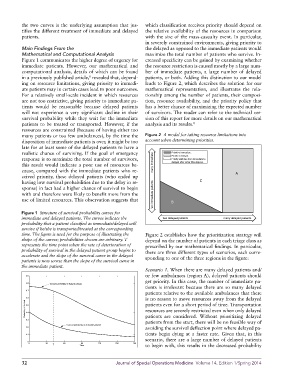
          in a previously published article,  revealed that, depend-  patients, or both. Adding this distinction to our model
          ing on resource limitations, giving priority to immedi-  leads to Figure 2, which describes the solution for our
          ate patients may in certain cases lead to poor outcomes.   mathematical representation, and illustrates the rela-
          For a relatively small-scale incident in which resources   tionship among the number of patients, their composi-
          are not too restrictive, giving priority to immediate pa-  tion, resource availability, and the priority policy that
          tients would be reasonable because delayed patients   has a better chance of maximizing the expected number
          will not experience a very significant decline in their   of survivors. The reader can refer to the technical ver-
          survival probability while they wait for the immediate   sion of this report for more details on our mathematical
          patients to be treated or transported. However, if the   analysis and its results. 8
          resources are constrained (because of having either too
          many patients or too few ambulances), by the time the   Figure 2  A model for taking resource limitations into
          disposition of immediate patients is over, it might be too   account when determining priorities.
          late for at least some of the delayed patients to have a
          realistic chance of surviving. If the goal of emergency   e   Prioritize immediate.
                                                                a  t  i  Prioritize delayed.
          response is to maximize the total number of survivors,   d  e  m  Priority switches from immediate to
          this result would indicate a poor use of resources be-  m  i     delayed after some time elapses.
                                                                y
          cause, compared with the immediate patients who re-   n  a  m
          ceived priority, these delayed patients (who ended up                                   A

          having low survival probabilities due to the delay in re-     s  t  n     C
          sponse) in fact had a higher chance of survival to begin   e  i  t  a
                                                                   p
          with and therefore were likely to benefit more from the   e  t  a
                                                                d  i
          use of limited resources. This observation suggests that   e  m
                                                                m       B
                                                                i

                                                                w
                                                                e
                                                                f
          Figure 1  Structure of survival probability curves for
          immediate and delayed patients. The curves indicate the   few delayed patients        many delayed patients
          probability that a patient classified as immediate/delayed will
          survive if he/she is transported/treated at the corresponding
          time. The figure is used for the purpose of illustrating the   Figure 2 establishes how the prioritization strategy will
          shape of the curves; probabilities chosen are arbitrary. T   depend on the number of patients in each triage class as
          represents the time point when the rate of deterioration of   prescribed by our mathematical findings. In particular,
          probability of survival in the delayed patient group begins to   there are three different types of scenarios, each corre-
          accelerate and the slope of the survival curve in the delayed   sponding to one of the three regions in the figure:
          patients is now worse than the slope of the survival curve in
          the immediate patient.
                                                             Scenario 1. When there are many delayed patients and/
                                                             or few ambulances (region A), delayed patients should
            0.9
                                                             get priority. In this case, the number of immediate pa-
            0.8       Survival probability of delayed patients
                                                             tients is irrelevant because there are so many delayed
            0.7
                                                             patients relative to the available ambulances that there
            0.6                                              is no reason to move resources away from the delayed
           Probability of Survival  0.5                      patients even for a short period of time. Transportation
                                                             resources are severely restricted even when only delayed
            0.4
            0.3                                              patients are considered. Without prioritizing delayed
                                                             patients from the start, there will be no feasible way of
                             Survival probability of immediate patients
            0.2                                              avoiding the survival deflection point where delayed pa-
                                                             tients begin dying at a faster rate. Given that, in this
            0.1
                                                             scenario, there are a large number of delayed patients
            0
             0      30     60     90     120     150    180
                       T          Time                       to begin with, this results in the decreased probability
          32                                     Journal of Special Operations Medicine  Volume 14, Edition 1/Spring 2014

