


Page 36 - Journal of Special Operations Medicine - Spring 2014
P. 36
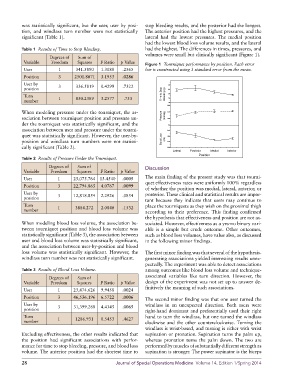
was statistically significant, but the user, user by posi-  stop bleeding results, and the posterior had the longest.
          tion, and windlass turn number were not statistically   The anterior position had the highest pressures, and the
          significant (Table 1).                             lateral had the lowest pressures. The medial position
                                                             had the lowest blood loss volume results, and the lateral
          Table 1  Results of Time to Stop Bleeding.         had the highest. The differences in times, pressures, and
                                                             volumes were small but clinically significant (Figure 1).
                      Degrees of   Sum of
           Variable   Freedom    Squares   F Ratio  p Value  Figure 1  Tourniquet performance by position. Each error
           User          1      341.5890   1.3088   .2565    bar is constructed using 1 standard error from the mean.
           Position      3      2501.8071  3.1953   .0286
           User by       3      336.5819   0.4299   .7322             50
           position                                                   40
           Turn          1      850.2389   3.2577   .753            Time to Stop  Bleeding (s)  30
           number                                                     20 10
                                                                      200
          When modeling pressure under the tourniquet, the as-        150
          sociation between tourniquet position and pressure un-    Pressure  (mmHg)  100
          der the tourniquet was statistically significant, and the   50
            association between user and pressure under the tourni-   250
          quet was statistically significant. However, the user-by-    200
          position and windlass turn numbers were not statisti-     Blood Loss  (ml)  150
          cally significant (Table 2).                                100
                                                                        Lateral  Posterior  Medial  Anterior
                                                                                   Position
          Table 2  Results of Pressure Under the Tourniquet.
                     Degrees of   Sum of                     Discussion
           Variable   Freedom    Squares   F Ratio  p Value
           User          1     25,075.764  13.4540  .0005    The main finding of the present study was that tourni-
           Position      3     22,794.865  4.0767   .0099    quet effectiveness rates were uniformly 100% regardless
                                                             of whether the position was medial, lateral, anterior, or
           User by       3     12,818.854  2.2926   .0854    posterior. These clinical and statistical results are impor-
           position                                          tant because they indicate that users may continue to
           Turn          1      3884.272   2.0840   .1532    place the tourniquets as they wish on the proximal thigh
           number                                            according to their preference. This finding confirmed
                                                             the hypothesis that effectiveness and position are not as-
          When modeling blood loss volume, the association be-  sociated. However, effectiveness as a yes-no binary vari-
          tween tourniquet position and blood loss volume was   able is a simple but crude outcome. Other outcomes,
          statistically significant (Table 3), the association between   such as blood loss volumes, have value also, as discussed
          user and blood loss volume was statistically significant,   in the following minor findings.
          and the association between user-by-position and blood
          loss volume was statistically significant. However, the   The first minor finding was that several of the hypothesis-
          windlass turn number was not statistically significant.  generating associations yielded interesting results unex-
                                                             pectedly. The experiment was able to detect associations
          Table 3  Results of Blood Loss Volume.             among outcomes like blood loss volume and technique-
                     Degrees of   Sum of                     associated variables like turn direction. However, the
           Variable   Freedom    Squares   F Ratio  p Value  design of the experiment was not set up to answer de-
                                                             finitively the meaning of such associations.
           User          1     23,474.626  9.9458   .0024
           Position      3     46,536.196  6.5722   .0006    The second minor finding was that one user turned the
           User by       3     31,399.288  4.4345   .0065    windlass in an unexpected direction. Both users were
           position                                          right-hand dominant and preferentially used their right
           Turn          1      1286.931   0.5453   .4627    hand to turn the windlass, but one turned the windlass
           number                                            clockwise and the other counterclockwise. Turning the
                                                             windlass is wrist-based, and turning is either with wrist
          Excluding effectiveness, the other results indicated that   supination or pronation. Supination turns the palm up,
          the position had significant associations with perfor-  whereas pronation turns the palm down. The two are
          mance for time to stop bleeding, pressure, and blood loss     performed by muscles of substantially different strength as
          volume. The anterior position had the shortest time to   supination is stronger. The power supinator is the biceps

          28                                     Journal of Special Operations Medicine  Volume 14, Edition 1/Spring 2014

