


Page 79 - ATP-P 11th Ed
P. 79
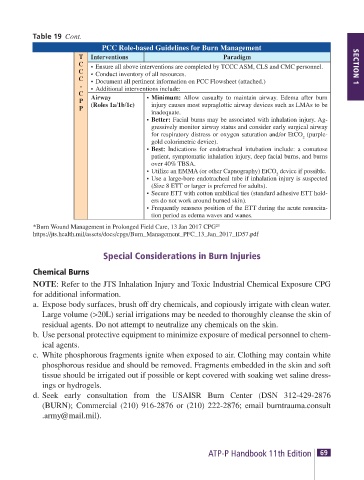
Table 19  Cont.
                       PCC Role-based Guidelines for Burn Management
                  T  Interventions                Paradigm
                  C   • Ensure all above interventions are completed by TCCC ASM, CLS and CMC personnel.  SECTION 1
                  C   • Conduct inventory of all resources.
                  C  • Document all pertinent information on PCC Flowsheet (attached.)
                  -   • Additional interventions include:
                  C   Airway     • Minimum: Allow casualty to maintain airway. Edema after burn
                  P   (Roles 1a/1b/1c)  injury causes most supraglottic airway devices such as LMAs to be
                  P
                                  inadequate.
                                 • Better: Facial burns may be associated with inhalation injury. Ag-
                                  gressively monitor airway status and consider early surgical airway
                                  for respiratory distress or oxygen saturation and/or EtCO  (purple-
                                                                   2
                                  gold colorimetric device).
                                 • Best: Indications for endotracheal intubation include: a comatose
                                  patient, symptomatic inhalation injury, deep facial burns, and burns
                                  over 40% TBSA.
                                 • Utilize an EMMA (or other Capnography) EtCO  device if possible.
                                                             2
                                 • Use a large-bore endotracheal tube if inhalation injury is suspected
                                  (Size 8 ETT or larger is preferred for adults).
                                 • Secure ETT with cotton umbilical ties (standard adhesive ETT hold-
                                  ers do not work around burned skin).
                                 • Frequently reassess position of the ETT during the acute resuscita-
                                  tion period as edema waves and wanes.
        *Burn Wound Management in Prolonged Field Care, 13 Jan 2017 CPG 23
        https://jts.health.mil/assets/docs/cpgs/Burn_Management_PFC_13_Jan_2017_ID57.pdf
                       Special Considerations in Burn Injuries
        Chemical Burns
        NOTE: Refer to the JTS Inhalation Injury and Toxic Industrial Chemical Exposure CPG
        for additional information.
        a.  Expose body surfaces, brush off dry chemicals, and copiously irrigate with clean water.
          Large volume (>20L) serial irrigations may be needed to thoroughly cleanse the skin of
          residual agents. Do not attempt to neutralize any chemicals on the skin.
        b. Use personal protective equipment to minimize exposure of medical personnel to chem-
          ical agents.
        c.  White phosphorous fragments ignite when exposed to air. Clothing may contain white
          phosphorous residue and should be removed. Fragments embedded in the skin and soft
          tissue should be irrigated out if possible or kept covered with soaking wet saline dress-
          ings or hydrogels.
        d. Seek early consultation from the USAISR Burn Center (DSN 312-429-2876
          (BURN); Commercial (210) 916-2876 or (210) 222-2876; email burntrauma.consult
          .army@mail.mil).


   68  SECTION 1   TACTICAL TRAUMA PROTOCOLS (TTPs)     ATP-P Handbook 11th Edition  69

