


Page 83 - ATP-P 11th Ed
P. 83
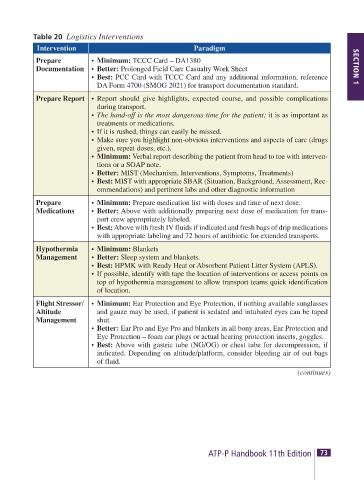
Table 20  Logistics Interventions
         Intervention                      Paradigm
         Prepare     •  Minimum: TCCC Card – DA1380
         Documentation •  Better: Prolonged Field Care Casualty Work Sheet    SECTION 1
                     •  Best: PCC Card with TCCC Card and any additional information, reference
                      DA Form 4700 (SMOG 2021) for transport documentation standard.
         Prepare Report •  Report should give highlights, expected  course, and possible complications
                      during transport.
                     •  The hand-off is the most dangerous time for the patient; it is as important as
                      treatments or medications.
                     •  If it is rushed, things can easily be missed.
                     •  Make sure you highlight non-obvious interventions and aspects of care (drugs
                      given, repeat doses, etc.).
                     •  Minimum: Verbal report describing the patient from head to toe with interven-
                      tions or a SOAP note.
                     •  Better: MIST (Mechanism, Interventions, Symptoms, Treatments)
                     •  Best: MIST with appropriate SBAR (Situation, Background, Assessment, Rec-
                      ommendations) and pertinent labs and other diagnostic information
         Prepare     •  Minimum: Prepare medication list with doses and time of next dose.
         Medications  •  Better: Above with additionally preparing next dose of medication for trans-
                      port crew appropriately labeled.
                     •  Best: Above with fresh IV fluids if indicated and fresh bags of drip medications
                      with appropriate labeling and 72 hours of antibiotic for extended transports.
         Hypothermia   •  Minimum: Blankets
         Management  •  Better: Sleep system and blankets.
                     •  Best: HPMK with Ready Heat or Absorbent Patient Litter System (APLS).
                     •  If possible, identify with tape the location of interventions or access points on
                      top of hypothermia management to allow transport teams quick identification
                      of location.
         Flight Stressor/  •  Minimum: Ear Protection and Eye Protection, if nothing available sunglasses
         Altitude     and gauze may be used, if patient is sedated and intubated eyes can be taped
         Management   shut.
                     •  Better: Ear Pro and Eye Pro and blankets in all bony areas, Ear Protection and
                      Eye Protection – foam ear plugs or actual hearing protection inserts, goggles.
                     •  Best: Above with gastric tube (NG/OG) or chest tube for decompression, if
                      indicated. Depending on altitude/platform, consider bleeding air of out bags
                      of fluid.
                                                                  (continues)


   72  SECTION 1   TACTICAL TRAUMA PROTOCOLS (TTPs)     ATP-P Handbook 11th Edition  73

