


Page 78 - ATP-P 11th Ed
P. 78
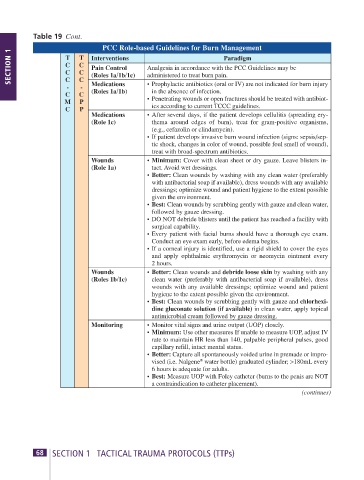
Table 19  Cont.
                       PCC Role-based Guidelines for Burn Management
   SECTION 1   T    T  Interventions  Analgesia in accordance with the PCC Guidelines may be
                                                  Paradigm
               C   C
                     Pain Control
               C   C
                     (Roles 1a/1b/1c)
                                 administered to treat burn pain.
               C
                -   C -   Medications   • Prophylactic antibiotics (oral or IV) are not indicated for burn injury
               C   C   (Roles 1a/1b)  in the absence of infection.
               M   P             • Penetrating wounds or open fractures should be treated with antibiot-
               C  P               ics according to current TCCC guidelines.
                     Medications    • After several days, if the patient develops cellulitis (spreading ery-
                     (Role 1c)    thema  around  edges  of  burn),  treat  for  gram-positive  organisms,
                                  (e.g., cefazolin or clindamycin).
                                 • If patient develops invasive burn wound infection (signs: sepsis/sep-
                                  tic shock, changes in color of wound, possible foul smell of wound),
                                  treat with broad-spectrum antibiotics.
                     Wounds      • Minimum: Cover with clean sheet or dry gauze. Leave blisters in-
                     (Role 1a)    tact. Avoid wet dressings.
                                 • Better: Clean wounds by washing with any clean water (preferably
                                  with antibacterial soap if available), dress wounds with any available
                                  dressings; optimize wound and patient hygiene to the extent possible
                                  given the environment.
                                 • Best: Clean wounds by scrubbing gently with gauze and clean water,
                                  followed by gauze dressing.
                                 • DO NOT debride blisters until the patient has reached a facility with
                                  surgical capability.
                                 • Every patient with facial burns should have a thorough eye exam.
                                  Conduct an eye exam early, before edema begins.
                                 • If a corneal injury is identified, use a rigid shield to cover the eyes
                                  and apply ophthalmic erythromycin or neomycin ointment every
                                  2 hours.
                     Wounds      • Better: Clean wounds and debride loose skin by washing with any
                     (Roles 1b/1c)  clean water (preferably with antibacterial soap if available), dress
                                  wounds with any available dressings; optimize wound and patient
                                  hygiene to the extent possible given the environment.
                                 • Best: Clean wounds by scrubbing gently with gauze and chlorhexi-
                                  dine gluconate solution (if available) in clean water, apply topical
                                  antimicrobial cream followed by gauze dressing.
                     Monitoring  • Monitor vital signs and urine output (UOP) closely.
                                 • Minimum: Use other measures If unable to measure UOP, adjust IV
                                  rate to maintain HR less than 140, palpable peripheral pulses, good
                                  capillary refill, intact mental status.
                                 • Better: Capture all spontaneously voided urine in premade or impro-
                                  vised (i.e. Nalgene  water bottle) graduated cylinder; >180mL every
                                             ®
                                  6 hours is adequate for adults.
                                 • Best: Measure UOP with Foley catheter (burns to the penis are NOT
                                  a contraindication to catheter placement).
                                                                   (continues)


          68  SECTION 1   TACTICAL TRAUMA PROTOCOLS (TTPs)                                                                    ATP-P Handbook 11th Edition  69

