


Page 76 - ATP-P 11th Ed
P. 76
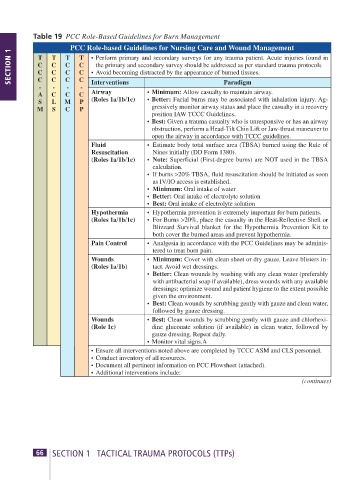
Table 19  PCC Role-Based Guidelines for Burn Management
                PCC Role-based Guidelines for Nursing Care and Wound Management
   SECTION 1  T   T   T    T  • Perform primary and secondary surveys for any trauma patient. Acute injuries found in
                  C
               C
            C
         C
                      the primary and secondary survey should be addressed as per standard trauma protocols
            C
         C
               C
                  C  • Avoid becoming distracted by the appearance of burned tissues.
         C
          -   C -   C -   C -   Interventions     Paradigm
         A   C   C    C   Airway    • Minimum: Allow casualty to maintain airway.
         S   L   M   P   (Roles 1a/1b/1c)  • Better: Facial burns may be associated with inhalation injury. Ag-
         M  S  C  P               gressively monitor airway status and place the casualty in a recovery
                                  position IAW TCCC Guidelines.
                                 • Best: Given a trauma casualty who is unresponsive or has an airway
                                  obstruction, perform a Head-Tilt Chin Lift or Jaw-thrust maneuver to
                                  open the airway in accordance with TCCC guidelines.
                     Fluid       •  Estimate body total surface area (TBSA) burned using the Rule of
                     Resuscitation   Nines initially (DD Form 1380).
                     (Roles 1a/1b/1c)  •  Note: Superficial (First-degree burns) are NOT used in the TBSA
                                  calculation.
                                 •  If burns >20% TBSA, fluid resuscitation should be initiated as soon
                                  as IV/IO access is established.
                                 •  Minimum: Oral intake of water
                                 •  Better: Oral intake of electrolyte solution
                                 •  Best: Oral intake of electrolyte solution
                     Hypothermia   •  Hypothermia prevention is extremely important for burn patients.
                     (Roles 1a/1b/1c)  •  For Burns >20%, place the casualty in the Heat-Reflective Shell or
                                  Blizzard Survival blanket for the Hypothermia Prevention Kit to
                                  both cover the burned areas and prevent hypothermia.
                     Pain Control  •  Analgesia in accordance with the PCC Guidelines may be adminis-
                                  tered to treat burn pain.
                     Wounds      •  Minimum: Cover with clean sheet or dry gauze. Leave blisters in-
                     (Roles 1a/1b)  tact. Avoid wet dressings.
                                 •  Better: Clean wounds by washing with any clean water (preferably
                                  with antibacterial soap if available), dress wounds with any available
                                  dressings; optimize wound and patient hygiene to the extent possible
                                  given the environment.
                                 •  Best: Clean wounds by scrubbing gently with gauze and clean water,
                                  followed by gauze dressing.
                     Wounds      • Best: Clean wounds by scrubbing gently with gauze and chlorhexi-
                     (Role 1c)    dine gluconate solution (if available) in clean water, followed by
                                  gauze dressing. Repeat daily.
                                 • Monitor vital signs.A
                     • Ensure all interventions noted above are completed by TCCC ASM and CLS personnel.
                     • Conduct inventory of all resources.
                     • Document all pertinent information on PCC Flowsheet (attached).
                     • Additional interventions include:
                                                                   (continues)


          66  SECTION 1   TACTICAL TRAUMA PROTOCOLS (TTPs)                                                                    ATP-P Handbook 11th Edition  67

