


Page 72 - ATP-P 11th Ed
P. 72
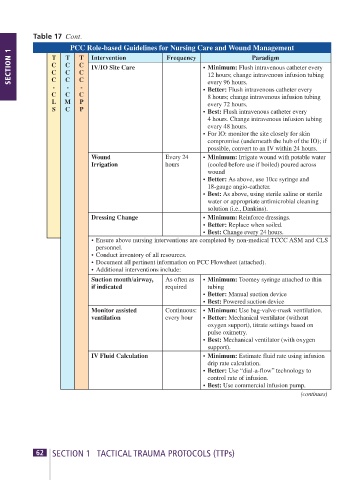
Table 17  Cont.
                PCC Role-based Guidelines for Nursing Care and Wound Management
   SECTION 1  T   T    T  Intervention  Frequency  • Minimum: Flush intravenous catheter every
                                                        Paradigm
               C   C
            C
                     IV/IO Site Care
            C
               C   C
                                              12 hours; change intravenous infusion tubing
            C
                                              every 96 hours.
             -   C -   C -                   • Better: Flush intravenous catheter every
            C   C   C                         8 hours; change intravenous infusion tubing
            L   M   P                         every 72 hours.
            S  C  P                          • Best: Flush intravenous catheter every
                                              4 hours. Change intravenous infusion tubing
                                              every 48 hours.
                                             • For IO: monitor the site closely for skin
                                              compromise (underneath the hub of the IO); if
                                              possible, convert to an IV within 24 hours.
                     Wound           Every 24  • Minimum: Irrigate wound with potable water
                     Irrigation      hours    (cooled before use if boiled) poured across
                                              wound
                                             • Better: As above, use 10cc syringe and
                                              18-gauge angio-catheter.
                                             • Best: As above, using sterile saline or sterile
                                              water or appropriate antimicrobial cleaning
                                              solution (i.e., Dankins).
                     Dressing Change         • Minimum: Reinforce dressings.
                                             • Better: Replace when soiled.
                                             • Best: Change every 24 hours.
                     • Ensure above nursing interventions are completed by non-medical TCCC ASM and CLS
                      personnel.
                     • Conduct inventory of all resources.
                     • Document all pertinent information on PCC Flowsheet (attached).
                     • Additional interventions include:
                     Suction mouth/airway,    As often as   • Minimum: Toomey syringe attached to thin
                     if indicated    required  tubing
                                             • Better: Manual suction device
                                             • Best: Powered suction device
                     Monitor assisted   Continuous:  • Minimum: Use bag-valve-mask ventilation.
                     ventilation     every hour  • Better: Mechanical ventilator (without
                                                oxygen support), titrate settings based on
                                              pulse oximetry.
                                             • Best: Mechanical ventilator (with oxygen
                                              support).
                     IV Fluid Calculation    • Minimum: Estimate fluid rate using infusion
                                              drip rate calculation.
                                             • Better: Use “dial-a-flow” technology to
                                              control rate of infusion.
                                             • Best: Use commercial infusion pump.
                                                                  (continues)


          62  SECTION 1   TACTICAL TRAUMA PROTOCOLS (TTPs)                                                                    ATP-P Handbook 11th Edition  63

