


Page 67 - ATP-P 11th Ed
P. 67
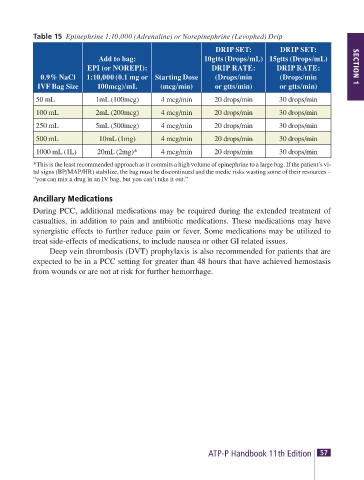
Table 15  Epinephrine 1:10,000 (Adrenaline) or Norepinephrine (Levophed) Drip
                                                DRIP SET:     DRIP SET:
                      Add to bag:            10gtts (Drops/mL)  15gtts (Drops/mL)
                    EPI (or NOREPI):           DRIP RATE:    DRIP RATE:       SECTION 1
          0.9% NaCl   1:10,000 (0.1 mg or  Starting Dose    (Drops/min    (Drops/min
         IVF Bag Size  100mcg)/mL   (mcg/min)   or gtts/min)  or gtts/min)
         50 mL        1mL (100mcg)  4 mcg/min   20 drops/min  30 drops/min
         100 mL       2mL (200mcg)  4 mcg/min   20 drops/min  30 drops/min
         250 mL       5mL (500mcg)  4 mcg/min   20 drops/min  30 drops/min
         500 mL        10mL (1mg)   4 mcg/min   20 drops/min  30 drops/min
         1000 mL (1L)  20mL (2mg)*  4 mcg/min   20 drops/min  30 drops/min
        *This is the least recommended approach as it commits a high volume of epinephrine to a large bag. If the patient’s vi-
        tal signs (BP/MAP/HR) stabilize, the bag must be discontinued and the medic risks wasting some of their resources –
        “you can mix a drug in an IV bag, but you can’t take it out.”
        Ancillary Medications
        During PCC, additional medications may be required during the extended treatment of
        casualties, in addition to pain and antibiotic medications. These medications may have
        synergistic effects to further reduce pain or fever. Some medications may be utilized to
        treat side-effects of medications, to include nausea or other GI related issues.
            Deep vein thrombosis (DVT) prophylaxis is also recommended for patients that are
        expected to be in a PCC setting for greater than 48 hours that have achieved hemostasis
        from wounds or are not at risk for further hemorrhage.


   56  SECTION 1   TACTICAL TRAUMA PROTOCOLS (TTPs)     ATP-P Handbook 11th Edition  57

