


Page 65 - ATP-P 11th Ed
P. 65
Sepsis Management
        a.  Blunt or penetrating injuries may cause sepsis in untreated or undertreated patients
        b. Early recognition of impending sepsis and immediate treatment are imperative to im-
          prove changes of survival                                           SECTION 1
        c.  Maintain a high degree of suspicion for signs of early and/or progressing sepsis while
          performing continuous triage
        d. Sepsis is defined as suspected or proven infection plus evidence of end organ dysfunction.
                                          17
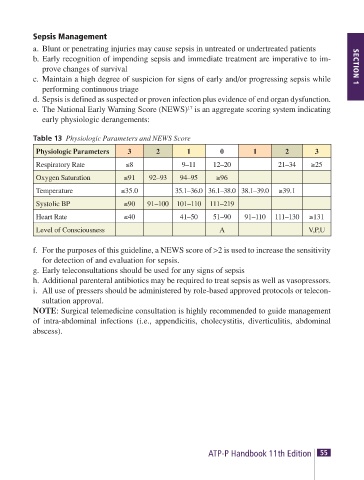
        e.  The National Early Warning Score (NEWS)  is an aggregate scoring system indicating
          early physiologic derangements:
        Table 13  Physiologic Parameters and NEWS Score
         Physiologic Parameters  3  2     1      0      1      2      3
         Respiratory Rate   ≤8           9–11  12–20          21–34  ≥25
         Oxygen Saturation  ≤91  92–93  94–95   ≥96
         Temperature       ≤35.0       35.1–36.0 36.1–38.0 38.1–39.0  ≥39.1
         Systolic BP        ≤90  91–100  101–110  111–219
         Heart Rate         ≤40         41–50  51–90  91–110  111–130  ≥131
         Level of Consciousness                  A                  V,P,U
        f.  For the purposes of this guideline, a NEWS score of >2 is used to increase the sensitivity
          for detection of and evaluation for sepsis.
        g. Early teleconsultations should be used for any signs of sepsis
        h. Additional parenteral antibiotics may be required to treat sepsis as well as vasopressors.
        i.  All use of pressers should be administered by role-based approved protocols or telecon-
          sultation approval.
        NOTE: Surgical telemedicine consultation is highly recommended to guide management
        of intra-abdominal infections (i.e., appendicitis, cholecystitis, diverticulitis, abdominal
        abscess).


   54  SECTION 1   TACTICAL TRAUMA PROTOCOLS (TTPs)     ATP-P Handbook 11th Edition  55

