


Page 60 - ATP-P 11th Ed
P. 60
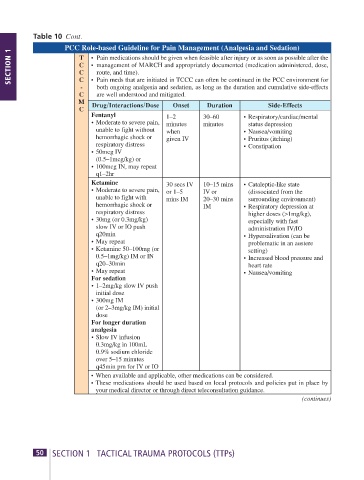
Table 10  Cont.
               PCC Role-based Guideline for Pain Management (Analgesia and Sedation)
   SECTION 1      T   •  Pain medications should be given when feasible after injury or as soon as possible after the
                  C   •  management of MARCH and appropriately documented (medication administered, dose,
                  C
                      route, and time).
                  C
                   -   •  Pain meds that are initiated in TCCC can often be continued in the PCC environment for
                      both ongoing analgesia and sedation, as long as the duration and cumulative side-effects
                  C    are well understood and mitigated.
                  M   Drug/Interactions/Dose  Onset  Duration  Side-Effects
                  C
                     Fentanyl        1–2     30–60    • Respiratory/cardiac/mental
                     • Moderate to severe pain,  minutes   minutes  status depression
                      unable to fight without   when   • Nausea/vomiting
                      hemorrhagic shock or   given IV  • Pruritus (itching)
                      respiratory distress            • Constipation
                     • 50mcg IV
                      (0.5–1mcg/kg) or
                     • 100mcg IN, may repeat
                      q1–2hr
                     Ketamine        30 secs IV  10–15 mins   • Cataleptic-like state
                     • Moderate to severe pain,  or 1–5   IV or    ( dissociated from the
                      unable to fight with   mins IM  20–30 mins     surrounding environment)
                      hemorrhagic shock or   IM       • Respiratory depression at
                      respiratory distress             higher doses (>1mg/kg),
                     • 30mg (or 0.3mg/kg)              especially with fast
                      slow IV or IO push                 administration IV/IO
                      q20min                          • Hypersalivation (can be
                     • May repeat                        problematic in an austere
                     • Ketamine 50–100mg (or           setting)
                      0.5–1mg/kg) IM or IN            • Increased blood pressure and
                      q20–30min                        heart rate
                     • May repeat                     • Nausea/vomiting
                     For sedation
                     • 1–2mg/kg slow IV push
                      initial dose
                     • 300mg IM
                      (or 2–3mg/kg IM) initial
                      dose
                     For longer duration
                     analgesia
                     • Slow IV infusion
                      0.3mg/kg in 100mL
                      0.9% sodium chloride
                      over 5–15 minutes
                      q45min prn for IV or IO
                     • When available and applicable, other medications can be considered.
                     • These medications should be used based on local protocols and policies put in place by
                      your medical director or through direct teleconsultation guidance.
                                                                   (continues)


          50  SECTION 1   TACTICAL TRAUMA PROTOCOLS (TTPs)                                                                    ATP-P Handbook 11th Edition  51

