


Page 77 - ATP-P 11th Ed
P. 77
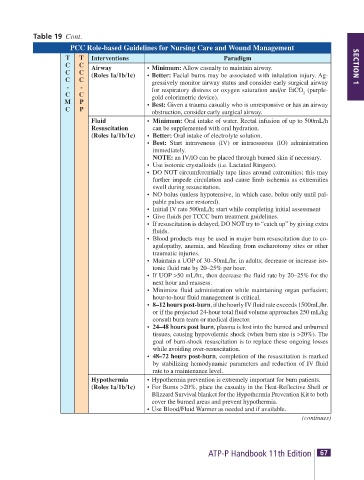
Table 19  Cont.
                PCC Role-based Guidelines for Nursing Care and Wound Management
               T    T  Interventions              Paradigm
               C   C   Airway    • Minimum: Allow casualty to maintain airway.  SECTION 1
               C   C   (Roles 1a/1b/1c)  • Better: Facial burns may be associated with inhalation injury. Ag-
               C  C               gressively monitor airway status and consider early surgical airway
                -   -             for respiratory distress or oxygen saturation and/or EtCO  (purple-
               C   C              gold colorimetric device).       2
               M   P             • Best: Given a trauma casualty who is unresponsive or has an airway
               C  P               obstruction, consider early surgical airway.
                     Fluid       •  Minimum: Oral intake of water. Rectal infusion of up to 500mL/h
                     Resuscitation   can be supplemented with oral hydration.
                     (Roles 1a/1b/1c)  •  Better: Oral intake of electrolyte solution.
                                 •  Best: Start intravenous (IV) or intraosseous (IO) administration
                                  immediately.
                                  NOTE: an IV/IO can be placed through burned skin if necessary.
                                 •  Use isotonic crystalloids (i.e. Lactated Ringers).
                                 •  DO NOT circumferentially tape lines around extremities; this may
                                  further impede circulation and cause limb ischemia as extremities
                                  swell during resuscitation.
                                 •  NO bolus (unless hypotensive, in which case, bolus only until pal-
                                  pable pulses are restored).
                                 •  Initial IV rate 500mL/h; start while completing initial assessment
                                 •  Give fluids per TCCC burn treatment guidelines.
                                 •  If resuscitation is delayed, DO NOT try to “catch up” by giving extra
                                  fluids.
                                 •  Blood products may be used in major burn resuscitation due to co-
                                  agulopathy, anemia, and bleeding from escharotomy sites or other
                                  traumatic injuries.
                                 •  Maintain a UOP of 30–50mL/hr. in adults; decrease or increase iso-
                                  tonic fluid rate by 20–25% per hour.
                                 •  If UOP >50 mL/hr., then decrease the fluid rate by 20–25% for the
                                  next hour and reassess.
                                 •  Minimize fluid administration while maintaining organ perfusion;
                                  hour-to-hour fluid management is critical.
                                 •  8–12 hours post-burn, if the hourly IV fluid rate exceeds 1500mL/hr.
                                  or if the projected 24-hour total fluid volume approaches 250 mL/kg
                                  consult burn team or medical director.
                                 •  24–48 hours post burn, plasma is lost into the burned and unburned
                                  tissues, causing hypovolemic shock (when burn size is >20%). The
                                  goal of burn-shock resuscitation is to replace these ongoing losses
                                  while avoiding over-resuscitation.
                                 •  48–72 hours post-burn, completion of the resuscitation is marked
                                  by stabilizing hemodynamic parameters and reduction of IV fluid
                                  rate to a maintenance level.
                     Hypothermia   • Hypothermia prevention is extremely important for burn patients.
                     (Roles 1a/1b/1c)  • For Burns >20%, place the casualty in the Heat-Reflective Shell or
                                  Blizzard Survival blanket for the Hypothermia Prevention Kit to both
                                  cover the burned areas and prevent hypothermia.
                                 • Use Blood/Fluid Warmer as needed and if available.
                                                                   (continues)


   66  SECTION 1   TACTICAL TRAUMA PROTOCOLS (TTPs)     ATP-P Handbook 11th Edition  67

