


Page 82 - ATP-P 11th Ed
P. 82
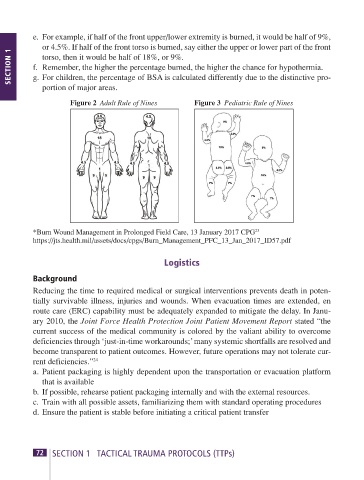
e.  For example, if half of the front upper/lower extremity is burned, it would be half of 9%,
          or 4.5%. If half of the front torso is burned, say either the upper or lower part of the front
   SECTION 1  f.  Remember, the higher the percentage burned, the higher the chance for hypothermia.
          torso, then it would be half of 18%, or 9%.
        g. For children, the percentage of BSA is calculated differently due to the distinctive pro-
          portion of major areas.
                Figure 2  Adult Rule of Nines  Figure 3  Pediatric Rule of Nines


        *Burn Wound Management in Prolonged Field Care, 13 January 2017 CPG 23
        https://jts.health.mil/assets/docs/cpgs/Burn_Management_PFC_13_Jan_2017_ID57.pdf

                                     Logistics
        Background
        Reducing the time to required medical or surgical interventions prevents death in poten-
        tially survivable illness, injuries and wounds. When evacuation times are extended, en
        route care (ERC) capability must be adequately expanded to mitigate the delay. In Janu-
        ary 2010, the Joint Force Health Protection Joint Patient Movement Report stated “the
        current success of the medical community is colored by the valiant ability to overcome
        deficiencies through ‘just-in-time workarounds;’ many systemic shortfalls are resolved and
        become transparent to patient outcomes. However, future operations may not tolerate cur-
        rent deficiencies.” 24
        a.  Patient packaging is highly dependent upon the transportation or evacuation platform
          that is available
        b. If possible, rehearse patient packaging internally and with the external resources.
        c.  Train with all possible assets, familiarizing them with standard operating procedures
        d. Ensure the patient is stable before initiating a critical patient transfer


          72  SECTION 1   TACTICAL TRAUMA PROTOCOLS (TTPs)                                                                    ATP-P Handbook 11th Edition  73

