


Page 20 - JSOM Spring 2026
P. 20
Observations and Discussion                        There was also the potential for conflicting medical  decision-
                                                             making. TAK provides all medical personnel with real-time
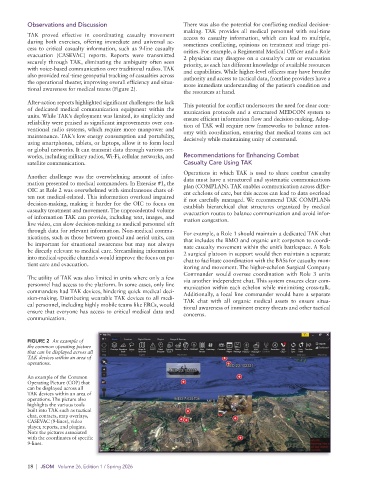
          TAK proved effective in coordinating casualty movement   access  to casualty information, which can lead to multiple,
          during both exercises, offering immediate and universal ac-  sometimes conflicting, opinions on treatment and triage pri-
          cess to critical casualty information, such as 9-line casualty   orities. For example, a Regimental Medical Officer and a Role
          evacuation (CASEVAC) reports. Reports were transmitted   2 physician may disagree on a casualty’s care or evacuation
          securely through TAK, eliminating the ambiguity often seen   priority, as each has different knowledge of available resources
          with voice-based communication over traditional radios. TAK   and capabilities. While higher-level officers may have broader
          also provided real-time geospatial tracking of casualties across   authority and access to tactical data, frontline providers have a
          the operational theater, improving overall efficiency and situa-  more immediate understanding of the patient’s condition and
          tional awareness for medical teams (Figure 2).
                                                             the resources at hand.
          After-action reports highlighted significant challenges: the lack   This potential for conflict underscores the need for clear com-
          of dedicated medical communication equipment within the   munication protocols and a structured MEDCON system to
          units. While TAK’s deployment was limited, its simplicity and   ensure efficient information flow and decision-making. Adop-
          reliability were praised as significant improvements over con-  tion of TAK will require new frameworks to balance auton-
          ventional radio systems, which require more manpower and   omy with coordination, ensuring that medical teams can act
          maintenance. TAK’s low energy consumption and portability,   decisively while maintaining unity of command.
          using smartphones, tablets, or laptops, allow it to form local
          or global networks. It can transmit data through various net-
          works, including military radios, Wi-Fi, cellular networks, and   Recommendations for Enhancing Combat
          satellite communication.                           Casualty Care Using TAK
                                                             Operations in which TAK is used to share combat casualty
          Another challenge was the overwhelming amount of infor-  data must have a structured and systematic communications
          mation presented to medical commanders. In Exercise #1, the   plan (COMPLAN). TAK enables communication across differ-
          OIC at Role 2 was overwhelmed with simultaneous chats of-  ent echelons of care, but this access can lead to data overload
          ten not medical-related. This information overload impaired   if not carefully managed. We recommend TAK COMPLANs
          decision-making, making it harder for the OIC to focus on   establish hierarchical chat structures organized by medical
          casualty treatment and movement. The unprecedented volume   evacuation routes to balance communication and avoid infor-
          of information TAK can provide, including text, images, and   mation congestion.
          live video, can slow decision-making as medical personnel sift
          through data for relevant information. Non-medical commu-  For example, a Role 1 should maintain a dedicated TAK chat
          nications, such as those between ground and aerial units, can   that includes the BMO and organic unit corpsmen to coordi-
          be important for situational awareness but may not always   nate casualty movement within the unit’s battlespace. A Role
          be directly relevant to medical care. Streamlining information   2 surgical platoon in support would then maintain a separate
          into medical-specific channels would improve the focus on pa-  chat to facilitate coordination with the BASs for casualty mon-
          tient care and evacuation.
                                                             itoring and movement. The higher-echelon Surgical Company
                                                             Commander would oversee coordination with Role 3 units
          The utility of TAK was also limited in units where only a few   via another independent chat. This system ensures clear com-
          personnel had access to the platform. In some cases, only line   munication within each echelon while minimizing cross-talk.
          commanders had TAK devices, hindering quick medical deci-  Additionally, a local line commander would have a separate
          sion-making. Distributing wearable TAK devices to all medi-  TAK chat with all organic medical assets to ensure situa-
          cal personnel, including highly mobile teams like ERCs, would   tional awareness of imminent enemy threats and other tactical
          ensure that everyone has access to critical medical data and   concerns.
          communication.


          FIGURE 2  An example of
          the common operating picture
          that can be displayed across all
          TAK devices within an area of
          operations.

          An example of the Common
          Operating Picture (COP) that
          can be displayed across all
          TAK devices within an area of
          operations. The picture also
          highlights the various tools
          built into TAK such as tactical
          chat, contacts, map overlays,
          CASEVAC (9-lines), video
          player, reports, and plugins.
          Note the pictures associated
          with the coordinates of specific
          9-lines.


          18  |  JSOM   Volume 26, Edition 1 / Spring 2026

