


Page 19 - JSOM Spring 2026
P. 19
medical operations, supporting the Battalion Medical Officers   The Role 2 surgical platoon’s officer in charge (OIC) coordi-
              and ensuring that casualties are evacuated efficiently through   nated with the Role 1 units and medical coordination cell via
              the echelons of care.  The Role 2 surgical company works   TAK. Role 2 physicians communicated directly with Role 1
              closely with Regimental Role 1 units ensuring effective casu-  providers, optimizing treatment plans through real-time text,
              alty evacuation and care, especially in amphibious operations   photos, and videos. For example, when a wave of casualties
              or other complex missions. 9,10  These units coordinate closely   was reported 40 minutes inbound via TAK, the medical teams
              to manage casualties through the continuum of care, ensuring   were able to prepare equipment and blood products in ad-
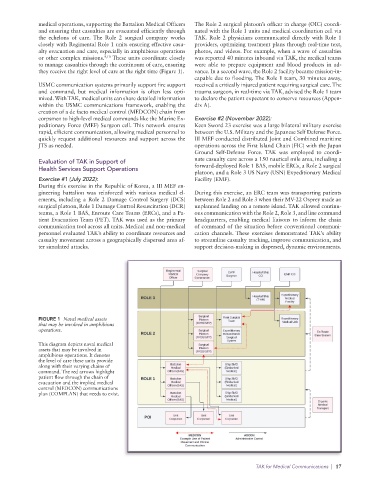
              they receive the right level of care at the right time (Figure 1).  vance. In a second wave, the Role 2 facility became mission-in-
                                                                 capable due to flooding. The Role 1 team, 30 minutes away,
              USMC communication systems primarily support fire support   received a critically injured patient requiring surgical care. The
              and command, but medical information  is often less opti-  trauma surgeon, in real-time via TAK, advised the Role 1 team
              mized. With TAK, medical units can share detailed information   to declare the patient expectant to conserve resources (Appen-
              within the USMC communications framework, enabling the   dix A).
              creation of a de facto medical control (MEDCON) chain from
              corpsmen to high-level medical commands like the  Marine Ex-  Exercise #2 (November 2022):
              peditionary Force (MEF) Surgeon cell. This network ensures   Keen Sword 23 exercise was a large bilateral military exercise
              rapid, efficient communication, allowing medical personnel to   between the U.S. Military and the Japanese Self Defense Force.
              quickly request additional resources and support across the   III MEF conducted distributed Joint and Combined maritime
              JTS as needed.                                     operations across the First Island Chain (FIC) with the Japan
                                                                 Ground Self-Defense Force.  TAK was employed to coordi-
              Evaluation of TAK in Support of                    nate casualty care across a 150 nautical mile area, including a
              Health Services Support Operations                   forward-deployed Role 1 BAS, mobile ERCs, a Role 2 surgical
                                                                 platoon, and a Role 3 US Navy (USN) Expeditionary Medical
              Exercise #1 (July 2022):                           Facility (EMF).
              During this exercise in the Republic of Korea, a III MEF en-
              gineering battalion was reinforced with various medical el-  During this exercise, an ERC team was transporting patients
              ements, including a Role 2 Damage Control Surgery (DCS)   between Role 2 and Role 3 when their MV-22 Osprey made an
              surgical platoon, Role 1 Damage Control Resuscitation (DCR)   unplanned landing on a remote island. TAK allowed continu-
              teams, a Role 1 BAS, Enroute Care Teams (ERCs), and a Pa-  ous communication with the Role 2, Role 3, and line command
              tient Evacuation Team (PET). TAK was used as the primary   headquarters, enabling medical liaisons to inform the chain
              communication tool across all units. Medical and non-medical   of command of the situation before conventional communi-
              personnel evaluated TAK’s ability to coordinate resources and   cation  channels. These  exercises  demonstrated TAK’s  ability
              casualty movement across a geographically dispersed area af-  to streamline casualty tracking, improve communication, and
              ter simulated attacks.                             support decision-making in dispersed, dynamic environments.


              FIGURE 1  Naval medical assets
              that may be involved in amphibious
              operations.

              This diagram depicts naval  medical
              assets that may be involved in
                amphibious operations. It denotes
              the level of care these units provide
              along with their varying chains of
              command. The red arrows highlight
              patient flow through the chain of
              evacuation and the implied medical
              control (MEDCON) communications
              plan (COMPLAN) that needs to exist.


                                                                                     TAK for Medical Communications  |  17

